Bed-Stuy: The Soul of Brooklyn’s Renaissance
If Brooklyn is the heart of Black America, Bedford-Stuyvesant—affectionately called Bed-Stuy—is its rhythm. It’s a rhythm you can feel in the verses of Biggie Smalls, see in the graceful brownstones lining the streets, and hear in the laughter shared on a stoop during a summer block party. The Bed-Stuy Black community remains one of New York’s largest and most influential, a testament to the fact that even as the city changes, a neighborhood’s culture can stand its ground and reinvent itself with grace. This is more than just a neighborhood; it’s a living legacy of Black resilience, creativity, and self-determination.
From Freedom’s Roots to the Frontlines of Culture
Bed-Stuy’s story began long before it became a global cultural capital. In the 19th century, it was a place where freed African Americans sought safety and opportunity. Its origins are deeply connected to Weeksville, one of the first free Black communities in the United States, which was established nearby in 1838. This legacy of self-determination is woven into the fabric of the neighborhood.
The modern Bed-Stuy began to take shape in the 1930s and 1940s. The opening of the A train subway line along Fulton Street in 1936 created a direct link to an overcrowded Harlem, prompting a wave of Black families to move to Bed-Stuy in search of better housing. By the 1960s, it was home to the highest concentration of Black people in New York City, blossoming into “Brooklyn’s Little Harlem”. This growing demographic power translated into political power. It was this community that elected Shirley Chisholm in 1968, making her the first Black woman to serve in Congress. She famously declared, “If they don’t give you a seat at the table, bring a folding chair,” a sentiment that continues to inspire local activists today.
Demographics: A Legacy in Motion
Today, Bed-Stuy is home to over 165,000 residents, with about 54% identifying as Black or African American. While rising rents and the pressures of gentrification have altered the landscape, Black culture remains its defining heartbeat. The neighborhood has seen an influx of new residents, but it has also become a hub for a new generation of Black homeowners and creatives, many of whom are second- and third-generation locals investing in the community that raised them. These young innovators are reclaiming the narrative through fashion, film, tech, and entrepreneurship, creating a bridge between what Bed-Stuy was and what it is becoming.
Within the Village: Micro-Neighborhoods with Big Soul
Bed-Stuy isn’t a monolith; it’s a collection of micro-neighborhoods, each with its own distinct personality.
- Stuyvesant Heights: Home to one of the largest collections of intact Victorian architecture in the country, this area is known for its stunning, well-preserved brownstones and a rich jazz heritage.
- Ocean Hill: A subsection founded in 1890, this area has a grittier feel and is brimming with youth energy and cultural experimentation. It was once a predominantly Italian enclave before becoming a center for the Black community in the 1960s.
- Tompkins Avenue Corridor: This street has become a vibrant hub for boutique Black-owned businesses, redefining Bed-Stuy’s economic and creative scene with shops, cafes, and galleries.
- Marcus Garvey Boulevard: Named for the Pan-African visionary, this boulevard remains a main artery of community life, reflecting the neighborhood’s deep historical and cultural pride.
Historic Landmarks and Cultural Beacons

Bed-Stuy’s history lives on through its landmark institutions, which continue to anchor the neighborhood.
- The Billie Holiday Theatre: Located within Restoration Plaza, this theater was founded in 1972 to provide a platform for local talent and expose the community to the arts. It has nurtured legendary artists like Samuel L. Jackson and remains a vital cultural force.
- Restoration Plaza: Home to the Bedford Stuyvesant Restoration Corporation (BSRC), founded in 1967, this is America’s first community development corporation. It was created to improve the quality of life for residents and continues to be a center for community events, small businesses, and cultural programming.
- Herbert Von King Park: One of the first parks in Brooklyn, it serves as a social anchor—a gathering place for elders, a playground for youth, and a stage for local musicians and cultural events.
Black Business and Bed-Stuy’s New Creative Economy
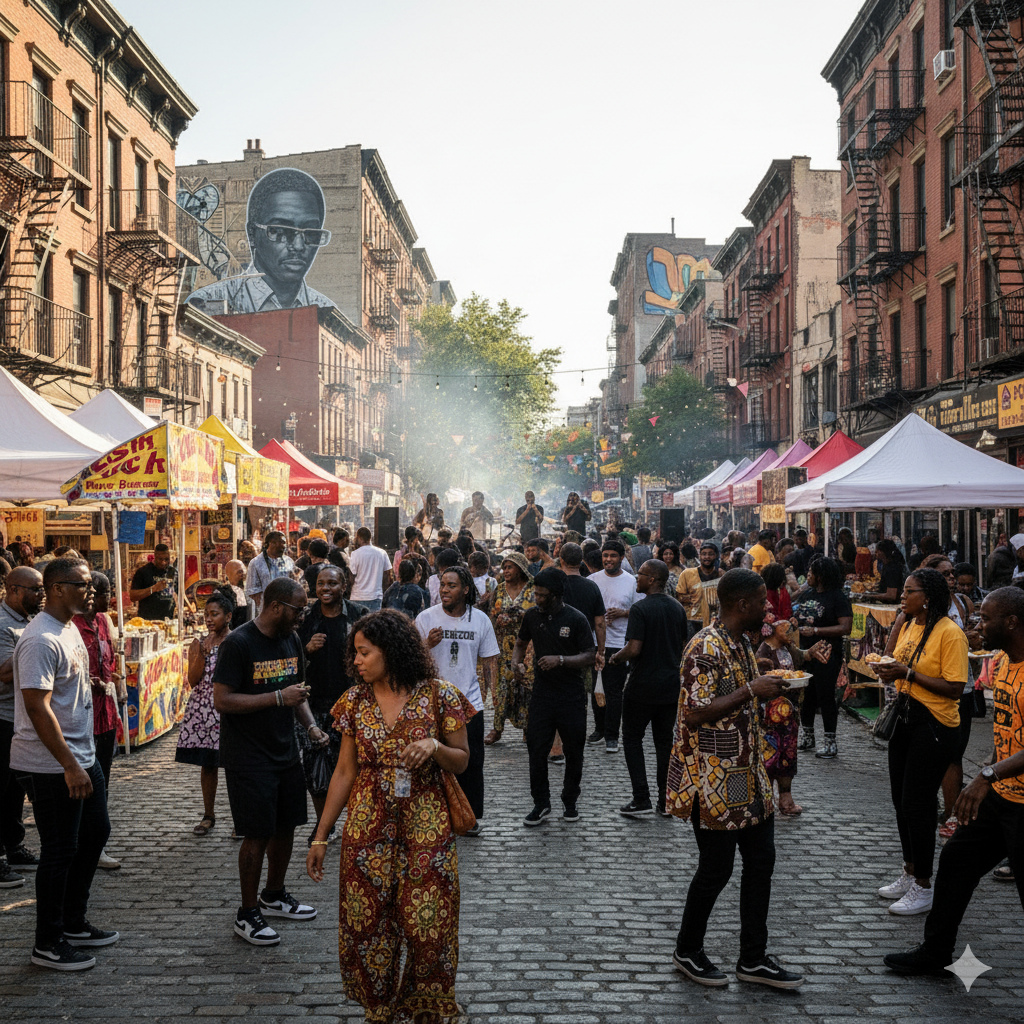
Bed-Stuy’s modern renaissance is powered by a thriving ecosystem of Black entrepreneurship. Businesses are redefining what community ownership and modern Black luxury look like.
- Retail and Lifestyle: Shops like Sincerely, Tommy, Peace & Riot, and BLK MKT Vintage have become destinations for fashion, home goods, and cultural artifacts.
- Food and Drink: Restaurants like Peaches and Grandchamps serve up Southern and Haitian comfort food, while bars like Bed-Vyne Wine and Lovers Rock offer craft beverages in a community-focused atmosphere.
Nonprofits like The Bridge Street Development Corporation continue to invest in youth leadership and economic empowerment, bridging generations through mentorship and opportunity. Younger founders are also carving their own lanes, with tech startups, digital agencies, and innovative fashion brands like Omondi and Savant Studios emerging from the neighborhood. Bed-Stuy’s Black community has proven that innovation isn’t new here—it’s heritage.
Culture That Moves the World
From Biggie Smalls’ verses to Mos Def’s lyricism, from Spike Lee’s iconic film Do the Right Thing to viral TikToks celebrating “Bedford-Stuyvesant Stories,” the neighborhood has always been a creative crucible. The music, fashion, and film coming out of Bed-Stuy don’t just reflect local pride—they export it globally. For young people navigating their identity in the digital age, Bed-Stuy is proof that authenticity still wins. It’s a place where you can be loud, proud, and Black—and that’s the whole point.
Politics and Civic Life
Bed-Stuy sits within New York’s 8th Congressional District, represented by House Minority Leader Hakeem Jeffries.Locally, the community is primarily represented by Council Member Chi Ossé in District 36 and falls under Brooklyn Community Board 3. These bodies and active civic groups tackle critical issues like housing justice, small business resilience, and youth mentorship. Residents can stay informed through:
- (https://www.nyc.gov/site/brooklyncb3/index.page)
- (https://council.nyc.gov/district-36/)
- (https://www.brooklynbp.nyc.gov/)
Bed-Stuy remains a Democratic stronghold, but more importantly, it’s a hub of grassroots organizing—where political engagement often begins at block association meetings and community centers.
Challenges and Change
Gentrification has brought both tension and transformation. Between 2010 and 2020, the neighborhood’s Black population decreased by 22,000, while the white population grew by 30,000. Rising property values have displaced longtime residents, even as new investments arrive. As one lifelong resident, Yvonne, put it, “Bed-Stuy is changing and we look for change, but don’t kick me out of it. A lot of us are being forced out of our homes because we can’t afford this rent”.
In response, organizations like Equality for Flatbush and mutual aid groups like Bed-Stuy Strong are fighting housing discrimination and food insecurity, while Black homeowners push back against predatory development. The conversation among youth is clear: progress must include preservation.
Why Bed-Stuy Matters
Bed-Stuy isn’t just a neighborhood—it’s a blueprint for Black renaissance. Its people have turned adversity into art, migration into a movement, and culture into a global currency. Whether you were born here, moved here, or simply visit, Bed-Stuy invites you to contribute—to shop local, support the arts, and keep its story alive. As one mural on Fulton Street reads, “Spread love, it’s the Brooklyn way.”
Key Takeaways
- Bed-Stuy remains a global symbol of Black creativity, resilience, and cultural pride.
- Youth entrepreneurs and creatives are fueling a modern renaissance rooted in the neighborhood’s rich traditions.
- For equitable growth to occur, preservation of the existing community and progress must coexist.
- The neighborhood’s soul thrives through storytelling, community ownership, and collective unity.
Call to Action
Support Bed-Stuy’s rebirth by visiting local Black-owned businesses, attending neighborhood festivals, and volunteering with organizations that protect its cultural legacy. The renaissance is here—be a part of it.
Related HfYC Content
-
The Hustle and the Heartbeat: Why Black Entrepreneurship in Brooklyn is Their Unbreakable Soul
-
The Housing Crossroads: Brooklyn’s Fight for a Place to Live
-
The Frontlines: Navigating Systemic Challenges in Black Brooklyn
Other Related Content
- (https://www.blackownedbrooklyn.com/) – A guide to discovering local Black-owned businesses and culture.
- (https://www.untappedcities.com/the-east-documentary/) – A documentary exploring the legacy of The East, a transformative 1970s pan-African cultural organization in Bed-Stuy.
References (APA Style)
- Bedford Stuyvesant Restoration Corporation. (n.d.). About. Retrieved from https://restorationplaza.org
- Bed-Stuy Strong. (n.d.). About Us. Retrieved from https://www.bedstuystrong.com/
- BlackPast. (2021). Bedford Stuyvesant, New York (1636- ). Retrieved from https://www.blackpast.org/african-american-history/bedford-stuyvesant-new-york-1636/
- Brooklyn Eagle. (2022, June 29). How Bedford-Stuyvesant Got Its Name. Retrieved from https://brooklyneagle.com/articles/2025/06/29/how-bedford-stuyvesant-got-its-name/
- CityNeighborhoods.nyc. (n.d.). Bedford-Stuyvesant. Retrieved from https://www.cityneighborhoods.nyc/bedford-stuyvesant
- CityNeighborhoods.nyc. (n.d.). Ocean Hill. Retrieved from https://www.cityneighborhoods.nyc/ocean-hill
- Equality for Flatbush. (n.d.). Anti-Gentrification. Retrieved from https://www.equalityforflatbush.org/anti-gentrification/
- Hampton Institute. (n.d.). Gentrification and the End of Black Communities. Retrieved from https://www.hamptonthink.org/read/gentrification-and-the-end-of-black-communities
- Jeffries, H. (n.d.). Congressman Hakeem Jeffries. Retrieved from https://jeffries.house.gov/
- MAAP | Mapping the African American Past. (n.d.). Bedford-Stuyvesant. Columbia University. Retrieved from https://maap.columbia.edu/mbl_place/50.html
- New York City Council. (n.d.). District 36 – Chi Ossé. Retrieved from https://council.nyc.gov/district-36/
- NYC Department of Small Business Services. (n.d.). Bedford-Stuyvesant Commercial District Needs Assessment. Retrieved from https://www.nyc.gov/assets/sbs/downloads/pdf/neighborhoods/avenyc-cdna-bedford-stuyvesant.pdf
- NYC Tourism. (n.d.). A Black-Owned Bed-Stuy Itinerary. Retrieved from https://www.nyctourism.com/articles/black-owned-bed-stuy-itinerary/
- Twomey, R. (n.d.). We Are Here. Retrieved from https://www.robyntwomey.com/we-are-here
- Wikipedia. (n.d.). Bedford–Stuyvesant, Brooklyn. Retrieved from https://en.wikipedia.org/wiki/Bedford%E2%80%93Stuyvesant,_Brooklyn
- With Love From Brooklyn. (n.d.). Celebrating Black History Month in Bed-Stuy. Retrieved from https://www.withlovefrombrooklyn.com/blogs/blog/celebrating-black-history-month-in-bed-stuy-1
-
-
-

-