New Jersey’s Fair Share Housing Battle
For decades, New Jersey has claimed a simple principle: every town must make room for everyone. But in March 2026, that promise is being tested at the highest level. As suburban municipalities push back against statewide housing mandates, the question isn’t just legal—it’s personal. Who gets access to opportunity, and who remains locked out of it?
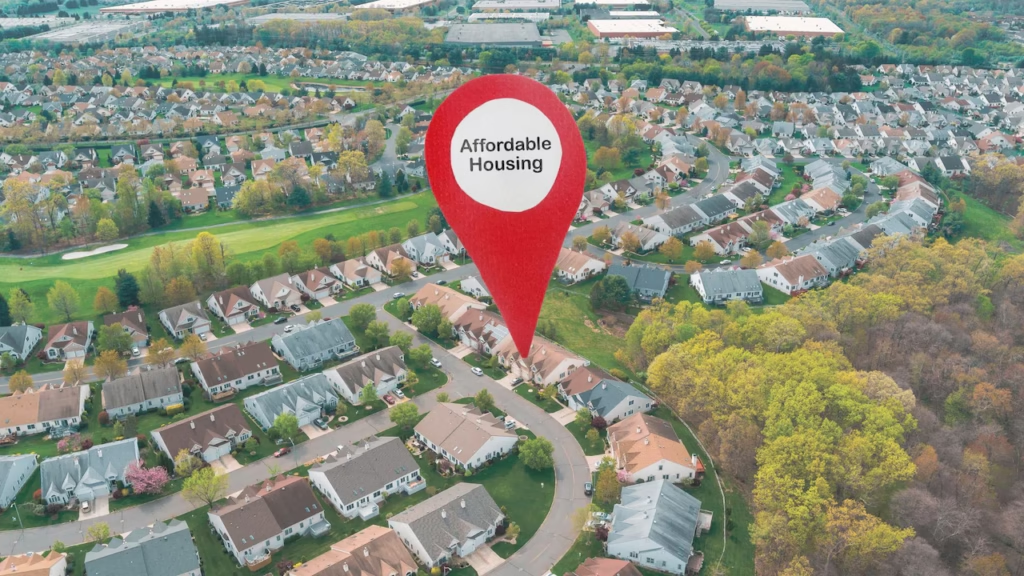
The Suburban Pushback and the “Urban Aid” Argument
At the center of this case is New Jersey’s long-standing “fair share” housing framework, rooted in the Mount Laurel Doctrine. The current mandate calls for the creation of 80,000+ affordable housing units by 2035 (Source Needed).
A coalition of more than 20 suburban towns has now asked the U.S. Supreme Court to intervene—seeking a freeze on these requirements.
Their core argument:
- The law creates an “unconstitutional burden” on suburban municipalities
- Cities like Newark are labeled “Urban Aid” and not required to take on new prospective obligations under the latest formula
On the surface, this sounds like a fairness issue.
But the deeper context matters.
Urban centers—Newark, Jersey City, Paterson—have historically absorbed the majority of affordable housing development. That didn’t happen by accident. It reflects decades of zoning decisions that restricted multi-family housing in suburban communities.
So when suburban leaders point to Newark’s “exemption,” critics see something else:
an attempt to avoid changing the rules that created exclusion in the first place.
What’s Actually at Stake: Access, Not Just Units


Affordable housing debates often get framed around numbers—units, quotas, deadlines.
But the real issue is access to opportunity.
When affordable housing is concentrated in already dense cities:
- School access remains unequal
- Wealth-building through homeownership stays limited
- Job proximity and transportation advantages remain uneven
Suburban resistance, whether intentional or not, reinforces a system where:
- High-resource areas remain economically exclusive
- Property appreciation benefits those already inside
- Entry barriers persist for Black and Brown families
This is how housing policy quietly shapes the regional wealth gap—not just through income, but through geography.
The Legal Delay Strategy—and Its Real-World Impact
If the Supreme Court grants a stay, the immediate outcome is not construction.
It’s pause.
That pause matters.
Housing advocates argue this type of appeal functions as a delay tactic (Source Needed):
- It slows compliance timelines
- It increases legal costs
- It creates uncertainty for developers and municipalities
And during that delay:
- Housing shortages continue
- Prices remain elevated
- First-time buyers and renters lose ground
For local entrepreneurs—what we call the Antrone Network—this instability isn’t abstract.
It affects where employees can live, how businesses scale, and whether communities can retain talent.
Newark’s “Urban Aid” Status: Relief or Containment?
Newark’s designation as an “Urban Aid” city is often framed as relief—it recognizes existing density and economic pressure.
But there’s another side to that reality.
When affordable housing is continuously directed into cities:
- It can reinforce the idea that cities are where affordability belongs
- It risks turning urban areas into containment zones for lower-income residents
- It limits true regional integration
This creates a double bind:
- Cities carry the burden
- Suburbs retain exclusivity
And the broader promise of fair housing—shared responsibility across all municipalities—remains incomplete.
A System at a Crossroads
This case isn’t just about whether towns must comply.
It’s about whether the structure of opportunity in New Jersey will actually change.
On one side:
- Municipal autonomy
- Concerns about density, infrastructure, and local control
On the other:
- State-level equity mandates
- A push to dismantle exclusionary zoning patterns
The outcome won’t just shape housing policy.
It will signal whether integration is still a goal—or just a legal concept that’s easier to defend than to implement.
Key Takeaways
- The Supreme Court appeal challenges not just housing mandates, but the principle of shared regional responsibility
- “Urban Aid” framing risks shifting focus away from long-standing suburban exclusion
- Delays in housing policy disproportionately impact renters, first-time buyers, and small business ecosystems
- The real issue extends beyond housing units to access to schools, jobs, and wealth-building opportunities
HfYC Poll of the Day
Follow us and respond on social media, drop some comments on the article, or write your own perspective!
Do you believe “Urban Aid” cities like Newark should be required to build even more affordable housing, or should the focus be strictly on forcing suburban towns to integrate?
Alternative framings:
- Should suburban towns be legally required to change zoning laws to allow more multi-family housing?
- Is the issue more about where housing is built—or the quality and long-term outcomes of that housing?
- Are housing mandates the right tool, or should incentives drive integration instead?
Related HfYC Content
- $600K New Jersey Racial Wealth Gap = Gentrification Today + Homelessness Tomorrow
- Building Power: How PLAs Shut Out Black Contractors
- What The Real Estate Moguls of NJ/NY Are Doing Right Under Your Nose
- The Housing Crossroads: Brooklyn’s Fight for a Place to Live
Other Related Content
- Fair Share Housing Center – Affordable Housing in New Jersey – https://fairsharehousing.org/
- New Jersey Mount Laurel Doctrine Overview (NJ Courts) – https://www.njcourts.gov/public/courts/civil/mountlaurel.html
- U.S. Supreme Court Housing & Zoning Case (Village of Euclid v. Ambler Realty Co.) – https://supreme.justia.com/cases/federal/us/272/365/