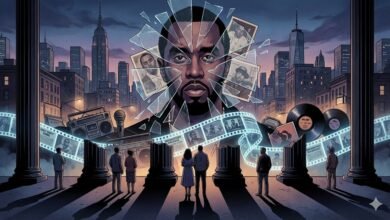

He exited the Rock the Country lineup after backlash, but the bigger story is how quickly Black artists get turned into symbols — with or without consent.
Editor’s Note
This piece isn’t an indictment of Ludacris or a call to “pick sides.” It’s an exploration of how quickly public association becomes political messaging in today’s America — and why Black artists often carry a different kind of risk when their names appear in spaces the culture reads as ideologically charged. We’re less interested in internet outrage, and more focused on what these moments reveal about power, perception, and the long shadow of proximity.

Ludacris didn’t get “canceled.” He got questioned.
When the 2026 lineup for Rock the Country went public, fans quickly noticed something that didn’t feel aligned with his legacy: Ludacris was listed alongside a slate of artists and branding widely perceived as right-coded, conservative Americana — with Kid Rock as a defining figure.
Backlash came fast. Not long after, Ludacris was off the bill.
The explanation reported across entertainment media was that his appearance was the result of a “mix-up,” that “lines got crossed,” and that he was never supposed to be part of the festival in the first place. But whether this was a genuine booking error or a decision reversed under pressure, the deeper conversation isn’t only about Ludacris.
It’s about what happens when Black artists are placed inside cultural spaces that are perceived as politically loaded — and how quickly “just business” turns into something else in a country that no longer agrees on what neutrality looks like.
Why This Hit a Nerve So Fast

There are certain environments in America that get understood as more than entertainment. They’re treated as identity signals — markers of who you are, who you’re for, and what you’ll tolerate.
A festival doesn’t have to label itself political for the public to interpret it as one. Sometimes the politics show up through association: the founder, the audience, the branding language, the partnerships, and the cultural figures attached to it.
Rock the Country leans into patriot symbolism and “American spirit” messaging. But in 2026, patriot branding isn’t neutral — especially when it’s linked to culture war icons. So when a Black artist with mainstream appeal appears on that stage — or even appears on the poster — people don’t read it as a random booking.
They read it as alignment. Or at minimum, permission.
The Unspoken Truth: Black Artists Don’t Get the Same Grace Around “Mix-Ups”
If you’re a Black artist, you don’t get to be “apolitical” in the same way others do.
You can be labeled political for where you perform, who you share a stage with, what you don’t condemn, what you don’t clarify, and who benefits from your proximity.
That’s why the “mix-up” explanation doesn’t land cleanly for everyone. Even if it’s true, the sequence is what triggers skepticism: a name appears publicly, backlash erupts, the name disappears, and the story becomes “he wasn’t supposed to be there.”
In a polarized America, that reads less like an accident and more like a failed experiment.
The Poster Is the Point

The most important detail here isn’t whether Ludacris would have actually performed.
It’s that in today’s culture, the listing itself is an artifact — a screenshot, a receipt, a moment that can outlive the truth.
And that’s where Black artists take a unique hit. Because they’re often invited into spaces that aren’t culturally “theirs,” while still being held responsible for the meaning of those spaces. Sometimes, intentionally or not, Black presence is used to soften the perception of an environment: See? It can’t be what you’re implying — look who’s on the lineup.
That dynamic is part of why these moments trigger something deeper than standard celebrity discourse. The backlash becomes less about one artist and more about resisting the move itself.
What Makes This Risky Long-Term
The conversation around Ludacris isn’t only about one festival listing. It reflects how quickly proximity can reshape a brand in a divided country.
Even if an artist pulls out, association can still influence:
Audience trust: For many fans, music isn’t separate from values. It’s identity, belonging, and community. When an artist’s choices feel politically confusing, trust can shift — especially in Black communities that already know how uneven the cultural terrain can be.
Brand partnerships and licensing: Companies don’t like controversy they can’t control. Even unproven associations create risk, which can affect endorsements, appearances, campaigns, and sponsorship opportunities.
Legacy and narrative: Once an artist is linked to a politically charged space, revisionist storytelling comes fast: He’s been leaning that way. He’s chasing a new audience. He’s doing it for the bag. Even when none of that is true, suspicion can stick.
The Bigger Question: Who Benefits From This Kind of Moment?

This is where things get uncomfortable. Because these controversies often generate attention for the event itself — free headlines, viral debate, and cultural visibility. Whether the artist stays or exits, the festival name travels.
Meanwhile, the Black artist absorbs the reputational turbulence, especially if their relationship with their core community is one of the main pillars protecting long-term cultural relevance.
That’s why many Black fans don’t treat moments like this as simple celebrity drama. They read it as a recurring strategy: Black cultural presence being used to broaden or legitimize spaces that were never designed around Black people — or Black outcomes.
In 2026, Proximity Is a Statement

We’re living in an era where entertainment and ideology blur into one public identity system. Not because everyone wants to politicize everything — but because politics itself has become lifestyle branding.
So the real takeaway isn’t just “Ludacris almost performed at a MAGA-coded festival.”
It’s that a Black artist doesn’t have to endorse anything to become part of a message. Sometimes all it takes is a flyer. Sometimes all it takes is a lineup. Sometimes all it takes is the screenshot.
Poll of the Day
Do you think Black artists should avoid performing at events that are politically coded—even if the event claims it’s “just music”? Add your feedback in the comments section or write your own article if there is another angle to this story!
- ✅ Yes — the long-term brand damage isn’t worth it
- ⚖️ It depends — context and audience matter
- ❌ No — artists should go wherever the money and fans are
- 🤔 Unsure — I’d need more information about the event
Related Here For You Central Reads
- Nicki Minaj, Trump, and the Political Weaponization of Black Women
- Malcolm X’s Warnings & Nicki Minaj at the UN
External Articles & Coverage
- Blavity — Ludacris Drops Out of “MAGA-Coded” Music Festival After Inclusion Called a “Mix-Up”
- Rolling Stone — Ludacris Removed From Rock the Country Lineup After Backlash (Reported “Mix-Up”)
- Entertainment Weekly — Ludacris Dropped From Rock the Country Lineup After Backlash
- People — Ludacris No Longer on Rock the Country Lineup After Backlash