

First-Time Black Homebuyer’s Guide to NJ & NY | Assistance & Grants
Introduction: More Than a House, It’s a Foundation
For generations, the dream of homeownership in America has been presented as the cornerstone of financial stability and upward mobility. For the Black community, however, this dream has often been deferred, obstructed by systemic barriers designed to keep us out. Today, the homeownership gap between Black and white households is a staggering 30 percentage points—as wide as it has been in over a century. This isn’t just a statistic; it’s a reflection of a deep and persistent wealth gap, fueled by historical injustices like redlining—the practice of systematically denying financial services to residents of Black neighborhoods.
But this guide is not about the obstacles of the past. It is a strategic playbook for the present, an assertion that homeownership is not just a dream to be wished for, but a goal to be achieved. It is an act of economic empowerment, a powerful tool for building generational wealth, and a way to plant roots for our families and our futures.
Navigating the fiercely competitive New Jersey and New York real estate markets can feel daunting, especially for a first-time buyer. But you are not alone, and you are not without resources. This guide is your roadmap. We will break down every step of the process in simple, clear terms—from strengthening your finances to unlocking tens of thousands of dollars in assistance. It’s time to reclaim the dream, build our legacy, and turn the key to a door that is rightfully yours.
Part 1: The Foundation – Preparing Your Empire
Before you start scrolling through listings, the most important work begins with you. Building a strong financial foundation is the first and most critical step in your homeownership journey. This preparation is about more than just qualifying for a loan; it’s about positioning yourself for long-term success.
Why This Matters: Homeownership as Economic Power
Owning a home is the primary way most Americans build wealth and secure their financial future. For our community, it is one of the most direct and effective tools for closing the racial wealth gap. Currently, for every $100 in wealth held by a white family, a Black family holds just $15. Home equity—the value of your home minus what you owe—is a powerful engine for changing that equation.
The benefits extend far beyond the financial. Stable homeownership is linked to better health outcomes, higher educational attainment for children, and a stronger sense of community. When you buy a home, you are not just acquiring property; you are investing in a stable environment for your family to thrive and creating an asset that can be passed down, providing a foundation for the next generation. This “why”—the pursuit of legacy, stability, and economic freedom—is the fuel that will power you through the challenges of the homebuying process.
Getting Your Financial House in Order (The Real Talk)
For Black homebuyers, financial preparation is both an offensive and a defensive strategy. Given that Black applicants historically face higher mortgage denial rates than their white counterparts, even at similar or higher income levels, building an undeniable financial profile is crucial. It’s not just about meeting the minimums; it’s about presenting a case so strong that it mitigates the risk of implicit bias influencing the lending decision.
Decoding Your Credit Score
Think of your credit score as your financial report card. Lenders use it to predict how likely you are to pay back a loan. A higher score means you’re seen as a lower risk, which can unlock better interest rates, saving you thousands over the life of your mortgage. While requirements vary, most lenders look for a score of 620 or higher for conventional loans, with more flexibility for FHA loans.
Here are simple, no-cost ways to boost your score:
- Pay Every Bill on Time: Payment history is the single biggest factor in your score.
- Keep Credit Card Balances Low: Aim to use less than 30% of your available credit limit.
- Check Your Reports for Free: You are entitled to a free credit report from all three major bureaus (Equifax, Experian, and TransUnion) annually. Review them for errors and dispute any you find.
Mastering Your Debt-to-Income (DTI) Ratio
Your DTI ratio is a percentage that shows how much of your monthly gross income goes toward paying your debts. Lenders use it to gauge your ability to handle a monthly mortgage payment. It’s calculated by dividing your total monthly debt payments (rent, car loans, student loans, credit cards) by your total monthly gross income.
Lenders typically look for two numbers, often using a guideline like the 35%/45% rule :
- Front-End Ratio (Housing): Your potential mortgage payment (Principal, Interest, Taxes, and Insurance, or PITI) should be no more than 35% of your gross monthly income.
- Back-End Ratio (Total Debt): Your total monthly debt payments, including your new mortgage, should be no more than 45% of your gross monthly income.
For the Black community, the student loan burden is a significant factor. A third of Black households carry over $40,000 in student debt, compared to just 18% of white households. This is not a personal failing but a systemic reality tied to the wealth gap. When applying for a mortgage, be prepared to provide clear documentation of your loan status and payment plan. Lenders have specific ways of calculating student loan payments, so discuss this with your loan officer early on.
The Down Payment Myth vs. Reality
One of the biggest myths in real estate is that you need a 20% down payment to buy a home. This is not true. In fact, many young buyers delay their homeownership journey because they mistakenly believe they need to save 11% to 20% down.
Many loan programs, like FHA loans, allow for down payments as low as 3.5%. More importantly, New Jersey and New York offer powerful down payment assistance programs (DPAs) that can provide you with thousands, or even tens of thousands, of dollars to cover your down payment and closing costs. These programs are the key to unlocking homeownership for many, and we will explore them in detail next.
Part 2: Unlocking Financial Power – Your Funding Toolkit
Securing the funds to buy a home involves two key components: the main mortgage loan and the assistance programs that make the upfront costs manageable. Understanding how these work together is your ticket to the closing table.
Your Mortgage Playbook
Before you can access assistance, you need to qualify for a primary mortgage. Here are the most common types:
- FHA Loans: Insured by the Federal Housing Administration, these loans are popular with first-time buyers due to their lower credit score requirements and low down payment minimum (3.5%). Many assistance programs in NJ and NY are designed to be paired with FHA loans.
- VA Loans: For eligible veterans, active-duty service members, and surviving spouses, these loans offer the incredible benefit of requiring no down payment.
- Conventional Loans: These are not insured by the government and typically require a higher credit score and a down payment of at least 3%.
The most important step in this phase is getting pre-approved. A pre-approval is a letter from a lender stating that they have reviewed your finances and are willing to lend you a specific amount. This is your golden ticket. It shows sellers you are a serious, qualified buyer and gives you a clear budget for your home search.
The Ultimate Cheat Sheet to NJ & NY Homebuyer Programs
This is where the game changes. New Jersey and New York have some of the most generous homebuyer assistance programs in the country. These are not handouts; they are strategic investments designed to build stronger communities and level the economic playing field.
New Jersey’s Top Programs for First-Time Buyers
New Jersey offers a suite of powerful programs through the New Jersey Housing and Mortgage Finance Agency (NJHMFA) and various cities.
- NJHMFA Down Payment Assistance (DPA): This is the state’s flagship program. It provides up to $15,000toward your down payment and closing costs. It’s structured as a 0% interest, five-year forgivable second loan. This means if you live in the home as your primary residence for five years, the loan is completely forgiven and you never have to pay it back.
- NJHMFA First Generation Down Payment Assistance Program: This is a groundbreaking program designed to build new legacies of homeownership. If you are a first-time homebuyer and a first-generation homebuyer (meaning your parents do not own a home) or if you have ever been in foster care in NJ, you may be eligible for an additional $7,000. When combined with the standard DPA, this could provide up to $22,000 in assistance.
- Live Newark Home Closing Cost Program: The city of Newark offers its own powerful incentive to encourage homeownership. This program provides a $20,000 forgivable loan for first-time buyers purchasing a home in the city. Like the state program, the loan is forgiven over five years as long as you live in the property.
- Trenton First-Time Homebuyer Program: Buyers in the state’s capital can access up to $15,000 for down payment and closing costs through a 0% interest loan that is forgiven after a 5-year residency period.
New York’s Power Plays for Homeownership
New York, particularly New York City, offers some truly transformative programs that can make owning a home a reality in one of the nation’s most expensive markets.
- NYC HomeFirst Down Payment Assistance Program: This is one of the most generous programs in the country, offering qualified first-time homebuyers up to $100,000 toward a down payment or closing costs on a home in any of the five boroughs. This assistance comes as a forgivable loan. To qualify, you must complete a homebuyer education course with a HUD-approved counseling agency, meet income requirements, and live in the home for at least 10 to 15 years, depending on the loan amount.
- SONYMA Down Payment Assistance Loan (DPAL): The State of New York Mortgage Agency (SONYMA) offers a DPAL that can be paired with its mortgage products. It provides the greater of $3,000 or 3% of the purchase price (up to a maximum of $15,000). This is a 0% interest loan with no monthly payments that is completely forgiven after 10 years.
- The Dearfield Fund: This innovative program offers a different approach to assistance. It provides up to $40,000for a down payment. It’s not a traditional loan with monthly payments. Instead, when you eventually sell or refinance the home, you repay the original $40,000 plus a small share (5%) of the home’s appreciation. This model allows the fund to replenish itself and help the next family on their journey, creating a cycle of community wealth-building.
Your choice of where to buy has a massive impact on the financial assistance you can receive. A first-generation buyer in New Jersey could access $22,000, while a buyer in Newark could get $20,000. A buyer in NYC could potentially access a life-changing $100,000. This demonstrates a crucial strategic link: the location you choose (Part 3) is directly tied to the funding you can unlock (Part 2).
| Table 1: New Jersey Down Payment Assistance at a Glance | |||
| Program Name | Max Assistance Amount | Type of Assistance | Key Requirement |
| NJHMFA DPA | $15,000 | 5-Year Forgivable Loan | First-Time Homebuyer, Paired with NJHMFA Mortgage |
| NJHMFA First Generation | $7,000 (in addition to DPA) | 5-Year Forgivable Loan | First-Generation Homebuyer or Former Foster Care Youth |
| Live Newark Program | $20,000 | 5-Year Forgivable Loan | Purchase a Home in Newark |
| Trenton FTHB Program | $15,000 | 5-Year Forgivable Loan | Purchase a Home in Trenton, Income Limits Apply |
Export to Sheets
| Table 2: New York Down Payment Assistance at a Glance | |||
| Program Name | Max Assistance Amount | Type of Assistance | Key Requirement |
| NYC HomeFirst | $100,000 | 10-15 Year Forgivable Loan | Purchase in NYC, Homebuyer Education, Income Limits |
| SONYMA DPAL | $15,000 | 10-Year Forgivable Loan | Paired with SONYMA Mortgage |
| The Dearfield Fund | $40,000 | Shared Appreciation Loan | Repay Principal + 5% of Appreciation Upon Sale |
Export to Sheets
Part 3: The Hunt – Finding Your Home in a Competitive Market
With your pre-approval in hand and a clear understanding of the assistance available, you are ready to begin the search. This phase is about strategy, patience, and having the right team in your corner.
Building Your A-Team
You are the CEO of this journey; it’s your job to hire the best experts to guide you.
- A Culturally Competent Realtor: Your real estate agent is your primary advocate. Seek out an agent who not only knows the local market inside and out but also understands the unique challenges and opportunities for Black buyers. They should be a trusted advisor committed to your best interests.
- A Knowledgeable Lender: Work with a lender who is an expert in the first-time homebuyer programs you plan to use. Not all lenders participate in every program, so it’s crucial to find one who can seamlessly integrate your assistance funds into your mortgage.
- A HUD-Approved Housing Counselor: This is your secret weapon. These counselors provide free, expert guidance on the entire homebuying process. For many of the best assistance programs, like NYC’s HomeFirst, working with a certified counselor is a requirement. They will help you navigate paperwork, understand your options, and prepare you for successful homeownership.
Navigating the NJ/NY Market: A Tale of Two Realities
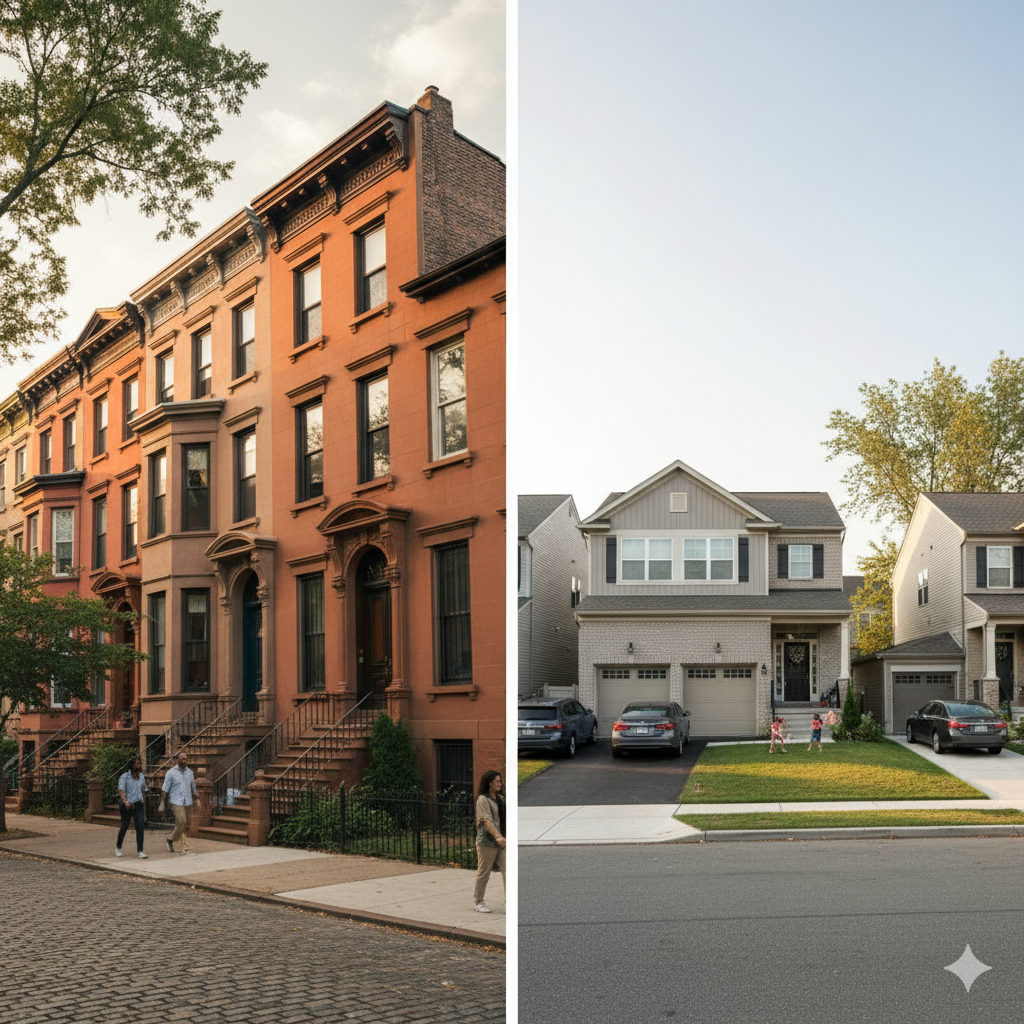
The New York and New Jersey metro area is a diverse market with a wide range of price points. While the headlines often focus on staggering prices, there are many communities where homeownership is well within reach.
- The Affordability Equation: The price differences can be stark. The median asking price in Brooklyn can top $1.1 million, while Manhattan is even higher. In contrast, the median sale price in East Orange, NJ, is around $525,000, and the average home value in the Bronx is approximately $487,000. Newark, while more expensive than the Bronx, still offers an average house cost significantly lower than Brooklyn.
- Strategic Search: These numbers tell a clear story. Areas like East Orange, Newark, and the Bronx represent strategic opportunities where your buying power is dramatically amplified. When you combine these more accessible home prices with the powerful, location-specific assistance programs, the path to ownership becomes much clearer.
However, it is critical to approach these more affordable markets with awareness. The very neighborhoods that are more accessible financially are often the same communities that were historically redlined and remain at the highest risk for appraisal bias. The affordability itself can be a symptom of the systemic undervaluation that has plagued Black neighborhoods for decades. This means your home search must include a plan to defend the value of your chosen property.
The Appraisal: Know Your Rights and Fight the Bias
The home appraisal is a critical step where an independent appraiser determines the market value of the property you want to buy. This value must be equal to or greater than the price you agreed to pay for the lender to approve your loan. Unfortunately, this is also a step where racial bias can have a devastating financial impact.
- Define the Threat: Appraisal bias occurs when an appraiser’s conscious or unconscious prejudice about a neighborhood’s racial or ethnic makeup leads them to value a home for less than it’s worth. Research from the Brookings Institution shows that homes in Black-majority neighborhoods are undervalued by an average of 23%, a gap that translates to a loss of about $48,000 in equity per home. With 97% of home appraisers being white, the potential for a biased perspective is a significant concern.
- Your Battle Plan: You are not powerless against a low appraisal. You can and should be proactive in defending your home’s value.
- Prepare a Proactive Package: Before the appraiser arrives, work with your realtor to create a package of information. Include a detailed list of all recent improvements, upgrades, and renovations to the property. Provide a list of at least three to five recent “comparable sales” (or “comps”)—similar homes in the area that have recently sold at or above your contract price.
- Scrutinize the Report: If the appraisal comes in low, review the report carefully. Look for factual errors (incorrect square footage, wrong number of bedrooms) and biased or coded language (e.g., describing the neighborhood as “predominantly Black” or using other racial descriptors). Check the comps the appraiser used. Are they truly similar to your property, or did the appraiser pull from a less desirable area to justify a lower value?
- Challenge the Value: If you find errors or evidence of bias, you have the right to challenge the appraisal. You can submit a “Reconsideration of Value” request to the lender, providing your evidence and comps to argue for a higher valuation.
Part 4: The Finish Line and Beyond
You’ve navigated the financial prep, secured your funding, and found the perfect home. The final steps are about closing the deal and beginning your life as a homeowner.

Closing Day: You Got the Keys!
Closing day is when you officially take ownership of your new home. You’ll meet with your lawyer, the seller’s representatives, and a title company agent to sign a large stack of legal documents. You will also pay your closing costs, which your down payment assistance funds are helping to cover. At the end of it all, you will be handed the keys. It is a moment of immense accomplishment and celebration.
Sustaining Your Legacy: The First Years of Homeownership
Getting the keys is the beginning, not the end, of your journey. Successful, sustainable homeownership requires planning and diligence.
- The True Cost of Ownership: Your monthly mortgage payment is just one piece of the puzzle. You must also budget for property taxes, homeowner’s insurance, utilities, and regular maintenance. Unexpected repairs are a leading cause of stress and regret for new homeowners, so building an emergency fund specifically for your home is essential.
- Protecting Your Investment: The financial hurdles for Black homeowners do not stop at closing. Studies show that over the life of a loan, Black homeowners pay thousands more due to higher interest rates, more expensive mortgage insurance, and higher property taxes—amounting to an estimated $67,320 in lost retirement savings. Be proactive in combatting this. Shop around for the best homeowner’s insurance rates, learn how to appeal your property tax assessment if you believe it’s unfairly high, and keep your credit strong so you can refinance to a lower interest rate when the opportunity arises.
- Understanding Your Assistance Loan: Remember the terms of your DPA. Most programs require you to live in the home for a set period (typically 5-15 years) for the loan to be forgiven. If you sell, refinance, or move out before that period is over, you may have to repay a portion of the assistance.
Conclusion: Your Journey is Just Beginning
The path to homeownership is a marathon, not a sprint. It requires preparation, persistence, and a team of advocates in your corner. For the Black community, it is a journey laden with historical context but also filled with profound opportunity. Homeownership is more than a transaction; it is a transformative act of building wealth, creating stability, and laying a foundation for generations to come.
You are now equipped with the knowledge and the strategies to navigate this process with confidence. You understand the market, you know about the powerful assistance programs waiting to help you, and you are prepared to advocate for yourself every step of the way.
Your journey is just beginning. The next step is to connect with a HUD-approved housing counseling agency. They are the experts who can provide personalized guidance and help you turn this plan into your reality. Take that step. Your legacy awaits.
Links and References
Related HfYC Content
- Unlocking the Dream: How the 203k Mortgage is Building Black Wealth in New Jersey
- Is the Housing Market for Black NJ Residents is Going Up in Smoke?
- The Bulldozer at the Gates: Can New Jersey’s Housing Reforms Finally Tear Down the Walls of Exclusion?
- The Silver Tsunami: How Boomers Are Winning the New Jersey Housing War
Other Related Content
- HUD FHA 203(k) Loan Program
- New Jersey Housing and Mortgage Finance Agency (NJHMFA) Homebuyer Programs
- New York City HPD HomeFirst Program: https://www.nyc.gov/site/hpd/services-and-information/homefirst-down-payment-assistance-program.page
- State of New York Mortgage Agency (SONYMA): https://hcr.ny.gov/sonyma
- Live Newark Program: https://www.newarknj.gov/card/live-newark-program
- The Dearfield Fund: https://www.dearfieldfund.com/
- HUD-Approved Housing Counseling Agency Locator: https://hud.gov/counseling







2 Comments