A Real-Talk Guide to Capitalism, Socialism, and Communism
Let’s be real: the words “capitalism,” “socialism,” and “communism” are getting thrown around everywhere. On social media, in classrooms, at the family cookout—it feels like you can’t escape the debate. For us, for Black America, these aren’t just academic terms. They’re the hidden architecture behind our paychecks, our rent, our student loans, and our health.
So why should we care? Because understanding the Black political economy—how these systems have helped, hurt, and shaped us—is the first step to building real power.
We’re a community that has always had to be innovative. We’ve been forced to navigate systems that weren’t built for us, and in doing so, we’ve created our own. From Black Wall Street to the Black Panthers’ breakfast programs, our history is a masterclass in using every tool in the box.
This isn’t about picking a team or winning a Twitter argument. This is about getting smart, getting strategic, and getting what our community deserves. Let’s break down what these “isms” really mean, how they show up in our daily lives, and how we can use this knowledge to build a better future together.

First Off, What System Are We Actually In?
One of the biggest misconceptions is that the United States is 100% pure capitalism. It’s not.
What we have is a democratic republic (we vote for people to represent us) with a mixed economy. Think of it like a playlist: the main genre is capitalism, but we’ve got a lot of socialist tracks mixed in, with a few other influences.
- The Capitalist Core: You can (in theory) start a business, own property, and compete in the market. This is the “hustle” part—the drive for profit and innovation.
- The Socialist Elements: We also have things that are collectively funded (through taxes) and run for the public good. Think: public schools, public libraries, Social Security, Medicare/Medicaid, our roads, and firefighters. These are all, at their core, socialist ideas meant to provide a safety net and basic services for everyone.
This mix is where the real political fights happen. When people argue about student loan forgiveness, universal healthcare, or funding public transit, they are arguing about where to draw the line between the capitalist “you’re on your own” mindset and the socialist “we’re in this together” approach.
Decoding the “Isms”: The Good, The Bad, and The Complicated
To make smart moves, we have to know the rules of the game. Let’s get past the scary labels and look at the playbook for each system.
💰 Capitalism: The Hustle and The Hazard
- The Core Idea: It’s all about private ownership and free markets. You, me, and any individual can own a business, land, or ideas. The “market” (supply and demand) decides prices, and the main goal is profit.
- The Theoretical Upside: It’s built to reward innovation, risk, and hard work. Competition can lead to better products and more choices. It’s the engine of immense wealth creation and personal freedom.
- The Practical Downside: If you don’t have money (capital) to start with, it’s incredibly hard to compete. It can lead to massive inequality (the rich get way richer). To maximize profit, businesses might cut corners, leading to low wages, exploitation of workers, and harm to the environment.
- The Black Lens: We have a deep and complex relationship with capitalism. It’s the dream of the Black-owned business, the “Buy Black” movement, and building generational wealth. Think of the success of FUBU, Madam C. J. Walker, or the vibrant entrepreneurship on “Black Wall Street.” But it’s also the system built on our ancestors’ forced labor. It’s the redlining that denied our grandparents’ mortgages, the venture capital that overlooks Black founders, and the gig economy that often traps our youth in low-pay, no-benefit jobs.
⚙️ Socialism: The Safety Net and The State
- The Core Idea: This is the “middle ground.” Socialism says, “Yes, you can own your own business, but the big, essential stuff? That should belong to everyone.” This means major industries like healthcare, energy, transportation, and education should be owned or heavily regulated by the public (i.e., the government) to make sure everyone has access.
- The Theoretical Upside: It’s designed to reduce inequality. Wealth is redistributed through taxes to pay for social programs. This creates a strong social safety net—think free college, universal healthcare, and robust unemployment benefits. It prioritizes fairness and community well-being over pure profit.
- The Practical Downside: “Redistribution” often means high taxes, especially for businesses and high earners. State-run industries can sometimes be inefficient, slow to innovate, and tangled in bureaucracy. There’s a risk of over-dependence on government programs.
- The Black Lens: Many of the things our community has fought for—and benefits from—are socialist policies. Medicaid and Social Security are lifelines for our elders. Public schools and HBCUs (which receive public funding) are pathways to opportunity. When we advocate for more funding for community health clinics or better public transit in our neighborhoods, we are, in effect, arguing for socialist solutions to problems capitalism created or ignored.
🔴 Communism: The Collective Ideal and The Control
- The Core Idea: This is the most radical of the three. Communism’s goal is a classless society where all property and means of production (factories, land) are collectively owned by the people. There is no private ownership. The idea is “from each according to his ability, to each according to his needs.”
- The Theoretical Upside: In a perfect communist world, there is no poverty. There are no rich or poor. Everyone is equal, and all needs (housing, food, healthcare) are met by the state, which plans the entire economy.
- The Practical Downside: In practice, this system has almost always led to authoritarian dictatorships and one-party rule. Central planning has proven to be incredibly inefficient, leading to shortages of basic goods. It also requires a total suppression of individual freedoms—no free speech, no free press, no free market.
- The Black Lens: While the practice of communism has been repressive, its language of fighting oppression and uplifting the working class has resonated with some Black liberation movements. The most famous example is the Black Panther Party. They weren’t communists in the sense of wanting a Soviet-style dictatorship. But they used socialist and communist ideas to create their “survival programs”—like the Free Breakfast for Children Program and free health clinics. They did this because both capitalism and the U.S. government were failing to meet the basic needs of the Black community. They saw a problem and fixed it themselves using a collective, community-first model.

Wait, Where Does “Marxism” Fit In?
Okay, so we’ve covered the big three “isms.” But there’s another word that gets thrown into the mix, often to make things sound scarier: Marxism.
So, what’s the deal?
Think of it this way: If socialism and communism are the systems (the “what”), Marxism is the theory (the “why” and “how”).
Marxism is a specific social, political, and economic theory developed by Karl Marx (and his homeboy Friedrich Engels).It’s not a government system itself, but an analysis of how the world works.
- The Core Idea: Marx looked at history and said it’s all one long story of “class struggle.” He argued that society is split into two main groups: the bourgeoisie (the small group of people who own the factories, land, and money—aka “the capital”) and the proletariat (the massive group of workers who have to sell their labor to survive).
- The Analysis: Marx’s big “hot take” was that capitalism is inherently exploitative. The owners will always try to pay the workers as little as possible to make more profit for themselves. He believed this system was unsustainable and would eventually lead to the workers (the proletariat) rising up in a revolution to seize control of the “means of production.”
- The Connection: In Marx’s theory, socialism is the transitional phase that comes after the revolution, where the state (run by the workers) takes control of everything to build a more equal society. The final, ultimate goal for Marx was communism—a classless, stateless, moneyless society where everyone contributes what they can and takes what they need.
In short: All Marxists are socialists, but not all socialists are Marxists. You can believe in social programs (like universal healthcare) without believing in a violent proletarian revolution.
Marxism and the Black Freedom Struggle
Here’s where it gets really relevant for us.
For over a century, Black radicals, intellectuals, and activists have engaged with Marxism—not always accepting it whole, but using its tools. Why? Because Marx gave them a powerful language to talk about economic exploitation.
When you’re facing a system that is both racist and capitalist, you need a critique that addresses both.
- The “Why”: People like W.E.B. Du Bois and C.L.R. James used Marxist theory to explain how capitalism was built on the slave trade and colonialism. They showed that the exploitation of Black labor was a foundation of the modern global economy.
- The “How”: This brings us back to the Black Panthers. They weren’t just reading Marx; they were adapting him. They saw that in America, “class” and “race” weren’t separate issues. They argued that the Black community was an “internal colony” within the U.S., exploited by both a racist system and a capitalist one.
- The Tool: Marxism provided a class analysis that many mainstream Civil Rights leaders weren’t using at the time. It helped the Panthers connect the dots between police brutality in Oakland, poverty in Chicago, and the Vietnam War. This is why their “survival programs” (like the breakfast program) were so revolutionary: they were a socialist practice designed to solve a problem that racist capitalism created.
Karl Marx himself was deeply influenced by the American abolitionist movement, famously writing, “Labor cannot emancipate itself in the white skin where in the black skin it is branded.” He saw that the fight for Black liberation and the fight for workers’ rights were tied together.
Why This Hits Home: From Gen Z to Our Grandparents

Understanding this stuff isn’t just for college professors. It has a direct impact on our lives, every single day.
- For Young Folks: The “default” system isn’t working for many. You’re staring down mountains of student debt (a fight over public vs. private funding), navigating a gig economy with no benefits (a pure capitalist problem), and paying sky-high rent (a crisis of housing-for-profit). It’s no wonder that many young people are more open to socialist ideas like universal healthcare or tuition-free college—they’re feeling the raw end of the current mix.
- Cross-Generational Insight: Our parents and grandparents often fought for access to the American capitalist dream. The Civil Rights Movement was about tearing down the legal barriers (segregation, redlining) that kept us from owning homes, getting good jobs, and starting businesses. Today, younger generations are building on that legacy by asking a new question: “It’s not enough to just have access to the system. Is the system itself fair?”
Both perspectives are 100% valid. We need the entrepreneurial spirit to build our own tables (capitalism) and the collective spirit to make sure everyone in our community has a place to sit and eat (socialism).
“Socialism” as the Ultimate Political Buzzword
Now you see why Gen Z and Millennials are looking at these ideas. But you also see why your grandparents might get a little tense when they hear the word “socialism.”
This is where we have to talk about the word itself—not just as a theory, but as a political talking point.
For much of the 20th century, “socialism” was the ultimate “scare word” in American politics.
The “Scare Word” Era: The Cold War
For 40 years, the U.S. was in a “Cold War” with the Soviet Union (a state built on authoritarian communism). During this time, a massive anti-communist and anti-socialist campaign, known as “McCarthyism,” swept the country.
- What Happened: Politicians, led by Senator Joseph McCarthy, created a “Red Scare.” They claimed “communist spies” were hiding everywhere—in the government, in Hollywood, and in schools.
- The Impact: Being called a “socialist” or “communist” could get you fired, blacklisted, or even jailed. It became a tool to crush dissent.
- The Impact on Us: This weapon was aggressively used against the Civil Rights Movement. The FBI and local police departments labeled leaders like Dr. Martin Luther King Jr., W.E.B. Du Bois, and Malcolm X as “communists” or “socialist agitators.” It was a deliberate tactic to discredit them and paint the fight for basic human rights as “anti-American.”
For generations of Americans, especially our elders, “socialism” became linked in their minds with dictatorship, gulags, and atheism—a direct threat to their country, their faith, and their freedom.
The “Rebrand” Era: Democratic Socialism
Fast forward to today. That Cold War history is exactly what’s being debated.
- The “Scare Word” Today: You’ll hear many politicians, especially on the right, use “socialism” as an attack. When they want to criticize a policy like “Medicare for All” or the “Green New Deal,” they don’t debate the details. They just label it “socialism,” trying to tap into that old Cold War fear. They’ll point to the very real failures and human rights abuses in places like Venezuela or Cuba as “proof” that all social programs lead to ruin.
- The “Rallying Cry” Today: On the other side, you have politicians like Bernie Sanders and Alexandria Ocasio-Cortez who have done the unthinkable: they’ve embraced the label. They call themselves “Democratic Socialists.”
This is a huge strategic move. By putting “democratic” in front, they are deliberately separating themselves from the old, authoritarian models. They’re not talking about a Soviet-style dictatorship. They are pointing to countries like Denmark, Sweden, and Norway—which are, by the way, still capitalist, mixed-economies—and saying, “We just want the good parts: free healthcare, free college, and a strong safety net.”
This is the political crossfire we’re all in. One side is using “socialism” to mean “authoritarian failure.” The other is using it to mean “a fairer, more caring mixed-economy.” This is why it’s so important for us to know the difference and see past the labels.
The Stakes: Today’s Bill, Tomorrow’s Legacy
The short-term and long-term impacts of these debates are massive.
- Short-Term Impact: This is all about your local and state elections. The person you elect to the city council is deciding on zoning laws (capitalism) and funding for the public park (socialism). The school board decides how to fund public education. The state legislature votes on expanding Medicaid (socialism) or giving tax breaks to corporations (capitalism). These “boring” local issues are where the “isms” become real life.
- Long-Term Impact: This is about the world we leave for our children. Will we build generational wealth through Black-owned businesses and property? Or will we focus on building community wealth through things like community land trusts (which keep housing affordable forever) and public-owned utilities? The answer is probably both. But we can’t be strategic if we don’t know the options.
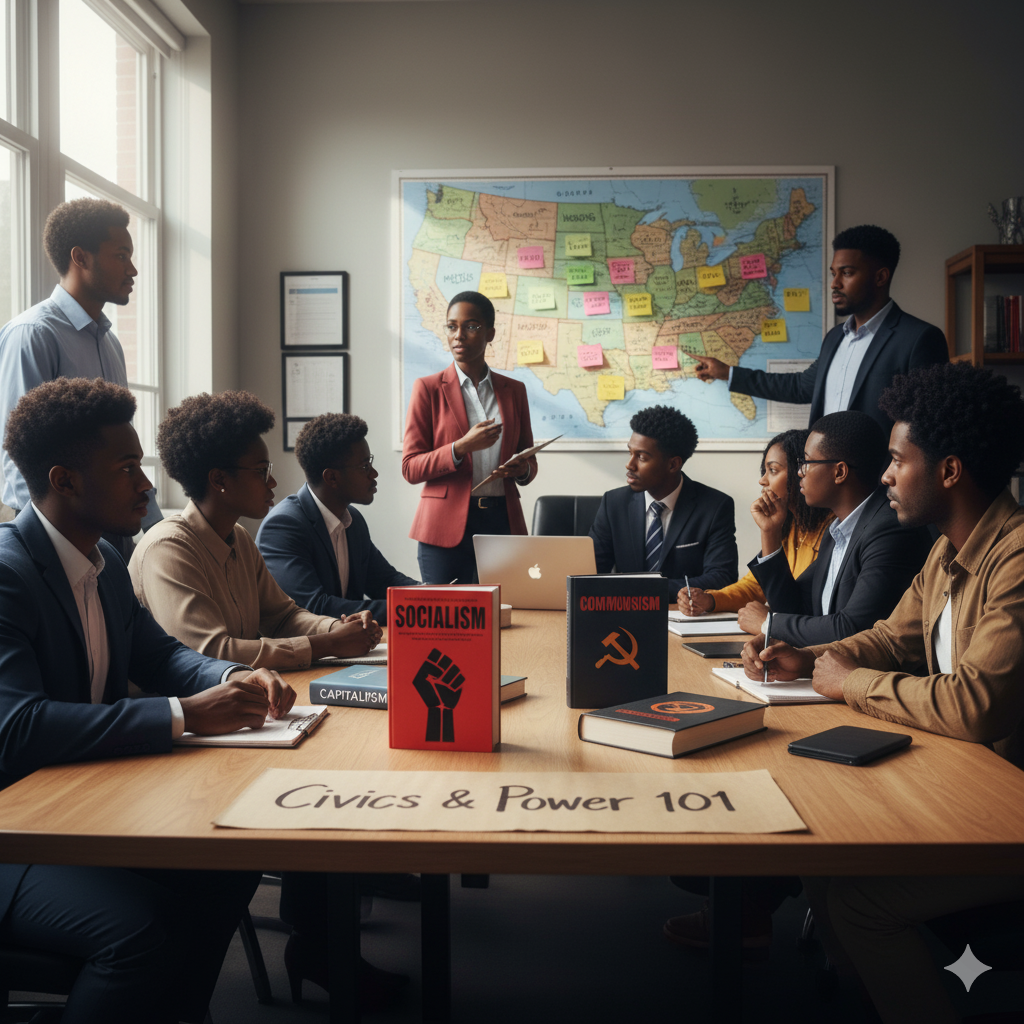
The Game Plan: How to Sound Informed and Make Moves
So, how do we, as a community, engage with these topics and build power? We move past the labels and focus on the outcomes.
When you’re in a debate or at a town hall, don’t just say “I’m a capitalist” or “I’m a socialist.” Instead, get specific.
- Lead with the Problem, Not the “Ism.”
- Instead of: “We need socialism!”
- Try: “The cost of insulin is too high. We need to cap the price so our elders don’t have to choose between medicine and food.”
- Instead of: “Capitalism is the only way!”
- Try: “We need to make it easier for Black entrepreneurs to get start-up loans so they can build businesses and create jobs in our community.”
- Ask “Who Benefits?”
- This is the ultimate question. When you see a new policy proposal (a new stadium, a new tax cut, a new housing development), always ask: “Who benefits from this, and who pays the cost?” If it benefits corporations at the expense of the community, challenge it. If it benefits the community, support it.
- Use Our History as a Playbook.
- We have always used a mixed strategy. We’ve built cooperative grocery stores (socialism) and celebrated Black-owned banks (capitalism). We’ve organized labor unions (collective power) and started tech companies (individual innovation). Our power lies in our pragmatism—our willingness to use any tool that works for us.
Your Key Takeaways & Our Next Steps
Here’s what to remember:
- Don’t Fear the Words: “Capitalism” and “Socialism” are just words for different tools. Don’t let people use them to scare or divide you. Get smart on what they actually mean.
- The US is a “Mix”: We live in a mixed economy. The real fight is about what we mix and how much of each ingredient we use.
- Our History is Our Guide: The Black Panther’s breakfast program (a social good) and Black Wall Street’s businesses (a capitalist good) are both vital parts of our legacy. We need both.
- Focus on Outcomes, Not Labels: The goal isn’t to be the “most socialist” or “most capitalist.” The goal is a community that is healthy, wealthy, safe, and free.
A Call to Action: What You Can Do This Week
- Get Informed: Don’t just take my word for it. Read up on these systems. (See the links below!)
- Get Local: Find out who your city council member and school board representative are. Look up the agenda for their next meeting. See how these big ideas are being debated in your own backyard.
- Start a Conversation: Talk to your friends, your family, your elders. Ask them what they think. Share this article. The more we talk, the smarter we all get.
- Support Both: The next time you have a dollar to spend, “Buy Black” from a local business (supporting Black capitalism). The next time you have an hour to spare, volunteer for a local mutual aid group (supporting Black community care).
We are the descendants of people who built thriving communities out of nothing. We have the history, the intelligence, and the hustle to navigate any system. The key is to do it with our eyes open.
Related HfYC Content
- Government Shutdown Impact on SNAP Benefits: Urgent for Black Community
- The Government Shutdown Step-by-Step: A Story of Power, Politics and Community Impact
- Is a Rightward Democratic Shift Still Aligned with Black Values?
- Little White Lies: The History of the “Welfare Queen” Stereotype
- Is Jasmine Crockett “Too Much”—or Exactly What This Moment Demands?
- Zohran Mamdani for Mayor: Firebrand, Policy Nerd, or the Change New York Actually Needs?
H2: Other Related Content
H2: References
- Marx, K., & Engels, F. (1848). The Communist Manifesto.
- History.com Editors. (2021). Black Panthers. A&E Television Networks.
- National Archives. (n.d.). A. Philip Randolph.
- Brookings Institution. (2020). Examining the Black-white wealth gap.
- Understanding Marxism: Differences vs. Communism, Socialism, Capitalism – Investopedia
- What The Heck Is The Difference Between Socialism and Marxism? – allriot
- How Black Marxists Have Understood Racial Oppression
- Marxism and Black Liberation: The Work of Raya Dunayevskaya – AAIHS