The 2026 Government Shutdown Cycle: Why Brooklyn and Jersey Families Keep Paying the Price for Washington’s Short-Term Fixes
Tomorrow marks another day where black families and communities are positioned as the pawns who have to choose between long-term government solutions and keeping the lights on…
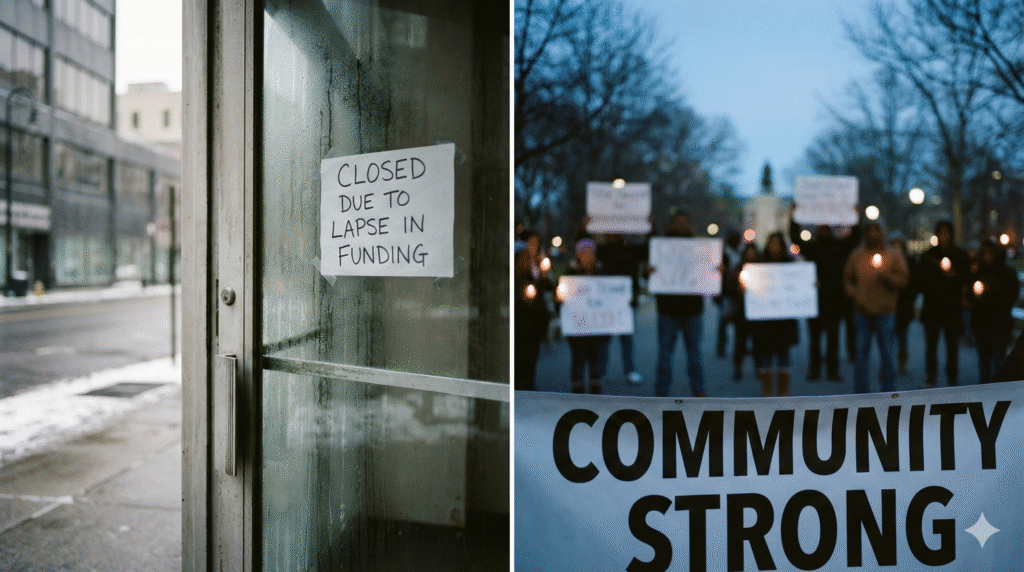
For families in Brooklyn, Jersey City, and Newark, the phrase “government shutdown” isn’t abstract. It lands at the dinner table. It delays benefits. It sends neighbors home without pay. And once again, Washington has set the clock.
Congress remains gridlocked over Department of Homeland Security (DHS) funding, pushing the government toward another shutdown. But this isn’t a one-off crisis—it’s a cycle. A pattern. And like all cycles, it hits hardest where stability is already fragile.

The Band-Aid Budget Strategy: What a Continuing Resolution Really Means
When Congress fails to pass a full-year budget, they use a tool called a Continuing Resolution (CR). It lets agencies keep spending at current levels, temporarily. No growth. No new investments. Just delay.
A CR is not a solution—it’s a pause button. And each time it expires, the threat of a shutdown resurfaces. Programs tied to community health, housing, and safety are left in limbo. Especially in places where federal presence is part of daily life.
What Happens When Washington Stalls
Not everything shuts down. But what gets called “non-essential” often feels essential in Black communities.
- Food Security (SNAP & WIC): These programs carry over funds for a few weeks. But new applications? Delayed. Recertifications? On hold. One bureaucratic pause can ripple into a crisis.
- Housing Delays: FHA loan processing slows down. That means delays for new homebuyers—many of whom are trying to close on their first property with support from federal programs.
- Federal Workers, Local Lives: TSA agents. HUD case managers. Admin staff at VA clinics. Many live right here. During shutdowns, they either work without pay or get furloughed.
This isn’t a Washington drama. It’s a neighborhood problem.
When Politics Weaponize Pain


The January 30 shutdown deadline isn’t just about spreadsheets. It’s about power. The debate over DHS funding took a turn after the fatal shooting of Alex Pretti, a 37-year-old ICU nurse and U.S. citizen, during a Minneapolis protest against immigration enforcement.
- Senate Democrats now refuse to pass DHS funding.
- Republicans insist the full budget be approved, including controversial enforcement measures.
The result? A legislative standoff where the shutdown isn’t a side effect. It’s leverage. The logic is brutal: Let the public feel the pain, then blame the other side.
Why This Shutdown May Last Longer
This isn’t just about balancing a budget. It’s a test of moral priorities. And because both sides see the Pretti case as a defining moment—either of accountability or enforcement strength—there is no quick compromise.
In political calculus, pain becomes pressure. And families become bargaining chips.
What to Do Now: Community First

If a shutdown is used as a tactic, community has to become a strategy.
- Health & Medication: Refill prescriptions early if you’re using VA or federally funded clinics.
- Documents & Deadlines: Download confirmations, application records, and contact info now. Don’t assume systems will stay accessible.
- Check on Neighbors: Especially those using WIC or waiting on housing paperwork. If the tap slows, the bucket needs to be ready.
How Did We Get Here? A Timeline of Recent Shutdowns
It wasn’t always like this. For decades, shutdowns were rare accidents, not scheduled programming. But in recent years, the timeline shows a clear shift toward weaponizing the budget.
- October 1976: The first “modern” shutdown lasted 10 days. It was a technical dispute, not a political standoff.
- 1995-1996 (21 Days): A major clash between President Clinton and House Speaker Newt Gingrich over Medicare and public health funding. This set the precedent for using shutdowns as a “showdown.”
- 2013 (16 Days): The “Affordable Care Act” shutdown. Congress deadlocked over funding Obamacare, stalling federal operations for over two weeks.
- 2018-2019 (35 Days): The longest shutdown in history (until recently) centered entirely on border wall funding. This was a direct precursor to today’s DHS dispute.
- October 2025 (43 Days): The most recent and painful chapter. Lasting from October 1 to November 12, this record-breaking shutdown signaled that the “guardrails” are gone. It ended only with a temporary Continuing Resolution (CR) that expires—you guessed it—on January 30, 2026.
The Takeaway: We are currently living in the “aftershocks” of the 2025 shutdown. The underlying fight (DHS Funding vs. Social Policy) was never resolved; it was just paused.
Key Takeaways
- Shutdown threats are no longer rare disruptions—they’re built into the system.
- The DHS budget standoff is about more than funding; it’s about federal policing power.
- In Brooklyn and North Jersey, shutdowns land hardest on households tied to federal services.
- Political leaders are using community pain as strategic leverage.
- Mutual aid, early preparation, and hyperlocal organizing are critical tools right now.
HfYC Poll of the Day
Follow us and respond on social media, drop some comments on the article, or write your own perspective!
Do you think federal shutdowns are being used as a weapon instead of a warning?
- Yes, it’s clearly a political tactic now.
- No, it’s just a breakdown in process.
- Maybe—but the consequences still land the same.
- I’m too busy surviving to follow the drama.
Related HfYC Content
- The Government Shutdown Step-by-Step
- The New Political Landscape: November 2025 Elections Impact
- Newark Stands Firm: Baraka and Pressley Lead Town Hall Against ICE Escalation
- Brooklyn’s Cost of Living Crisis – Who Gets to Stay, Who’s Being Pushed Out?
Other Related Content
- Congressional Research Service: What is a Continuing Resolution?
- Impact of Shutdowns on SNAP & WIC — FRAC
- US Bank: Economic Impact of the 2025 Shutdown