
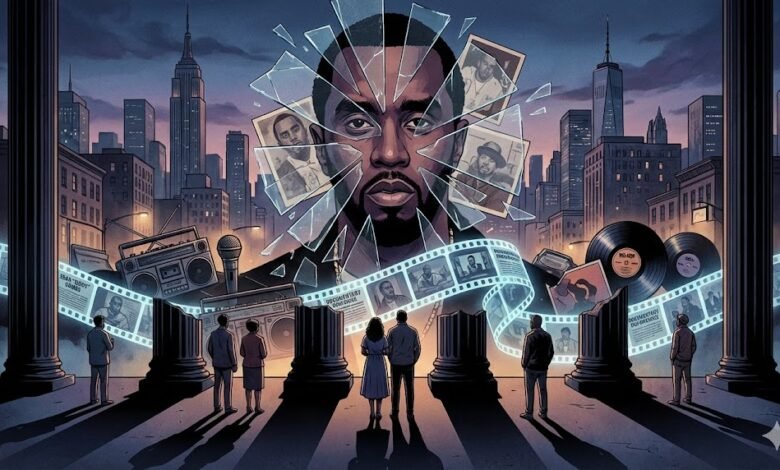
The Diddy Legacy Documentary – Is it Time to Rethink Power & Accountability in Hip-Hop
Continuation of the HfYC Investigative Series: Part 4
The Diddy legacy documentary has arrived at a moment when the culture is still processing the shockwaves of his federal trial, the 77 ongoing civil cases, and decades of whispered allegations finally coming into full public view. For those following our earlier trilogy—Part 1: Power, Perception, and Punishment, Part 2: Cultural Dynamics & the Hip Hop House, and Part 3: The Media & The Mob—this latest installment is less a surprise and more a culmination.
The Netflix docuseries Sean Combs: The Reckoning doesn’t simply recap allegations. It forces a confrontation with evidence, personal testimonies, and behind-the-scenes footage that reshapes public understanding of who Sean “Diddy” Combs has been—and who he has been allowed to be.
If legacy is defined by narrative control, then this documentary marks the moment control finally slipped from his hands.It is a mirror held up not just to one man, but to the industry that enabled him and the fans who looked the other way.
When the Curtain Pulls Back: A Legacy Rewritten in Real Time
For years, Diddy’s empire ran on an immaculate balance of charisma, visibility, mythmaking, and power. He was the blueprint for the Black mogul: a kid from Harlem who refused to stay small, who turned a paper route into a private jet.He was the embodiment of the “American Dream” remix—Black excellence codified in linen suits and Hamptons parties.
But the Diddy legacy documentary cracks open newer, darker layers—layers even longtime critics didn’t fully grasp. We aren’t just seeing the cracks in the armor; we are seeing the machinery beneath it.
The Private Footage That Changed Everything
The most jarring aspect of the series is the never-before-seen footage of Combs pacing a New York hotel suite, arguing with his lawyer, demanding a “dirty” media expert, and venting about losing the public relations war. This isn’t the cool,collected Puff Daddy of the 90s videos.
This is an unguarded look at:
- A man who knows the walls are closing in and is scrambling for an exit.
- A public figure obsessed with image over accountability, treating legal/moral crises as PR fires to be extinguished.
- A mogul who has spent decades mastering narrative architecture—now watching it collapse in real-time.
This footage fundamentally alters how viewers understand his downfall. It’s not just scandal. It’s the unraveling of a strategy that worked for thirty years, until suddenly, it didn’t.
What the Documentary Reveals — and Why It Hits Different Now
The docuseries doesn’t rely on shock factor alone. It leans on accumulation—the sheer weight of stories stacking up until the denial creates a structural failure.
Jurors Speak, and the Question of Impartiality Gets Messy
In a move that has lit up social media group chats, two jurors from the proceedings reveal a troubling layer of fandom influencing justice. A former assistant claims some jurors were visibly “starstruck.” One juror is caught on camera questioning Cassie Ventura’s credibility with the chilling phrase: “You can’t have it both ways.”
This isn’t simply about Diddy—it’s about how celebrity distorts systems meant to protect victims and seek truth. It begs the question: Can a figure this culturally massive ever truly face a jury of his peers, or are we all too influenced by the playlist of our lives to see the facts?
Aubrey O’Day’s Account Reignites a Pattern We’ve Been Avoiding
Aubrey O’Day’s testimony, including the allegation of sexual assault she claims to have no memory of due to intoxication, reinforces a long pattern of power imbalance. The documentary amplifies a recurring motif: women who felt trapped, controlled, and silenced inside the Bad Boy machine. For Gen Z viewers, this resonates deeply with current conversations about coercion and the inability to consent under duress—themes that older generations often brushed under the rug of “rockstar lifestyle.”
Al B. Sure! and Kirk Burrowes Speak on Biggie, Talent, and Responsibility
Perhaps the most explosive revelation is not the accusations of abuse—but the assertion by former associates that Diddy “ushered Biggie to his death” by blocking a European tour and keeping him in Los Angeles at the height of the East–West tension.
If Biggie’s death has long symbolized hip-hop’s stolen innocence, then linking Diddy’s strategic decisions to that tragedy reframes the entire 90s narrative. It suggests that the quest for dominance didn’t just cost money; it cost lives.
Tupac, Biggie, and the Mythology Diddy Can No Longer Outrun
For decades, the murders of Tupac Shakur and The Notorious B.I.G. lived in cultural limbo—debated endlessly in barbershops and forums, solved rarely. The documentary pushes the conversation into uncomfortable territory by threading together:
- Diddy’s proximity to the escalating East–West feud.
- His strategic decision-making leading up to Biggie’s last days.
- Newly surfaced footage contextualizing his fear, ego, and political maneuvering during the height of the beef.
This is where the Diddy legacy documentary hits hardest: It refuses to let nostalgia sanitize history. It demands that we look at the Bad Boy era not just for the hits, but for the collateral damage.
The 1991 City College Stampede — The First Warning We Ignored
Long before Bad Boy Records became a global powerhouse, before the shiny suits, before MTV, Diddy promoted an overcrowded charity basketball game at City College that ended in a deadly stampede. Nine lives were lost. Dozens were injured.
Yet, his career skyrocketed immediately afterward.
The documentary reframes this moment as the opening act of a career marked by tragedy without consequence. When viewed through a 2025 lens, especially by younger activists who prioritize community safety over celebrity worship, it becomes clear: What we once dismissed as mismanagement now looks like a blueprint for escaping accountability.
Politicians, Power, and Timing: Were They Waiting for the Votes?

One cannot ignore how eerily convenient the timing of political distancing was. Hours after the documentary’s release,suddenly lawmakers, former allies, and long-time defenders began issuing statements of “concern,” “shock,” or “reevaluation.”
But we have to ask the uncomfortable question: Where were these voices a week earlier?
Where was this energy when survivors spoke without cameras? Where was the courage before public sentiment shifted? A skeptical reader might conclude that some political figures waited until after the recent election cycle—until votes were secured—to break ranks with Diddy. They didn’t speak up because of a moral awakening; they spoke up to avoid alienating the very voters they still needed.
The documentary didn’t create outrage. It simply made silence more expensive.
The Question Hanging Over Hip-Hop: How Do We Honor Artistic Impact When the Architect Is Complicated?
Diddy shaped hip-hop in ways few executives ever have:
- Reinventing the producer-as-performer model.
- Curating an era-defining sound that blended R&B smoothness with hip-hop grit.
- Introducing artists who redefined the genre.
- Building a media empire (Revolt) that influenced global Black culture.
And yet…
Can Musical Greatness Outweigh the Harm?
This is where younger audiences, especially Gen Z and Gen Alpha, diverge sharply from previous generations. The youth don’t separate art from ethics by default. They ask:
- Who paid the price for this greatness?
- Who was hurt so others could rise?
- What harm are we indirectly endorsing when we celebrate icons without questioning them?
Diddy’s influence remains undeniable. But influence without accountability is no longer culturally acceptable. The documentary forces a reckoning: Is legacy earned through impact alone—or through the integrity behind the impact?
How Communities Are Processing What Remains of His Legacy

Different generations are reacting to the Diddy legacy documentary in distinct ways, creating a complex dialogue within the Black community.
- For Older Fans: He represents a golden era of hustle and Black excellence. The fall feels personal—like a rupture in cultural identity. It is a mourning of a time when “Bad Boy for Life” felt like a promise, not a threat.
- For Younger Viewers: They see a cautionary tale about power, unregulated celebrity, and the failures of institutions designed to protect the vulnerable. They are less interested in the “genius” and more interested in the “enabler.”
- For Survivors Across the Industry: The documentary is a validation—long overdue, emotionally fraught, but necessary.
Legacy isn’t static. The culture is rewriting it in real time.
What Happens Now? The Short- and Long-Term Implications
Short-Term Impacts
- Viral Accountability: A surge in public criticism and online discourse, with TikTok and Twitter serving as the new “court of public opinion.”
- Legal Pressure: Renewed legal attention to the 77 pending cases, as the documentary provides potential leads and corroborating patterns.
- The Great Distancing: Industry figures silently scrubbing their socials and distancing themselves to avoid reputational fallout.
Long-Term Impacts
- Deconstructing Mogul Worship: A reevaluation of how we worship figures in entertainment. The “by any means necessary” ethos is being challenged by a call for ethical leadership.
- Systemic Safety: Stronger support for survivor advocacy within hip-hop and calls for transparency in music industry labor and safety structures.
- Redefining Excellence: A generation redefining what “Black excellence” means—prioritizing substance, mental health, and community safety over mere spectacle and wealth accumulation.
The Takeaway: Legacy Is No Longer a One-Way Story

The Diddy legacy documentary doesn’t answer every question—but it closes the chapter where Sean Combs controlled the narrative. What comes next isn’t up to him. It’s up to the culture.
What the Community Can Do Next
- Support Survivor-Centered Organizations: Shift resources to groups protecting women and vulnerable youth in the industry.
- Demand Transparency: Push for accountability within entertainment institutions.
- Engage Critically: Teach youth that success without humanity isn’t success.
- Amplify Hyperlocal Storytelling: Use platforms like Here For You Central to tell our own stories, ensuring the truth isn’t filtered through a PR machine.
Legacy isn’t about erasing greatness. It’s about telling the whole story—finally.
HfYC Poll of the Day
Do you think the Diddy legacy documentary finally shows the real story, or is it just the moment everyone decided he was no longer profitable to protect?
Alternative Perspectives:
- Has the Diddy legacy documentary changed your view of him — or just confirmed what the culture already knew?
- Is Diddy’s downfall about justice, or about people jumping ship once the public turned?
- Can Diddy’s musical impact survive the revelations in the documentary, or is this the moment his legacy truly ends?
Related HfYC Content
- Part 1/4 – Power, Perception, and Punishment: The Trial of Diddy and the Question of Justice for Black Moguls
- Part 2/4 – Cultural Dynamics & the Hip Hop House
- Part 3/4 – The Media & The Mob
- Epstein Files, Power Games & Public Trust: Why the Latest Revelations Matter for Black America
- Congress Voted on the Epstein Files, Now What?
- Dubai Porta Potty – Securing the Bag or Sex Trafficking Crisis?
- Bros Gone Wild — Passport Bros vs the FBA
- Thanksgiving Tea 2025: The Black Holiday Trending Stories Everyone Was Talking About
Other Related Content
- How Hip-Hop’s Golden Era Shaped Modern Music – Rolling Stone
- Celebrity Influence and the Justice System: A Research Overview – Pew Research Center
References
- Netflix. (2025). Sean Combs: The Reckoning [Docuseries].
- Pew Research Center. (2023). Celebrity Influence and Public Perception of Justice.
- Rolling Stone. (2024). How Hip-Hop’s Golden Era Shaped Modern Music.


One Comment