Building Power: How PLAs Shut Out Black Contractors — And What It Will Take to Fix It
The debate over Black contractors and PLAs isn’t new — but it is reaching a boiling point. As New Jersey positions itself for the largest infrastructure boom in decades, from schools to clean energy to transportation, a quiet gatekeeping mechanism continues to shape who gets to build the state’s future.
That mechanism is the Project Labor Agreement, or PLA. And for the 98% of Black construction workers who are not union signatory, PLAs function less like a path to opportunity and more like a locked door with a sign that says “access denied.”
In a moment where billions in public dollars are flowing, this isn’t just a policy issue — it’s a question of equity, ownership, and who gets written into the story of economic growth.
This piece continues HfYC’s mission to spotlight the structural dynamics shaping Black life. And yes, it’s time to talk plainly about the math, the politics, and the intentional design that keeps Black contractors at the margins of an industry they helped build.
HfYC Poll of the Day
Are PLAs protecting workers, or are they just another way to keep Black contractors off billion-dollar jobs?
Alternative Perspectives:
- If 98% of Black construction workers can’t work on PLA projects, is the system “fair” — or just familiar?
- Should NJ raise the PLA threshold so Black contractors can finally compete on public projects?
- Are PLAs building New Jersey’s future — or building a wall around who gets access?
Follow us and respond on social media, drop some comments on the article, or write your own perspective!
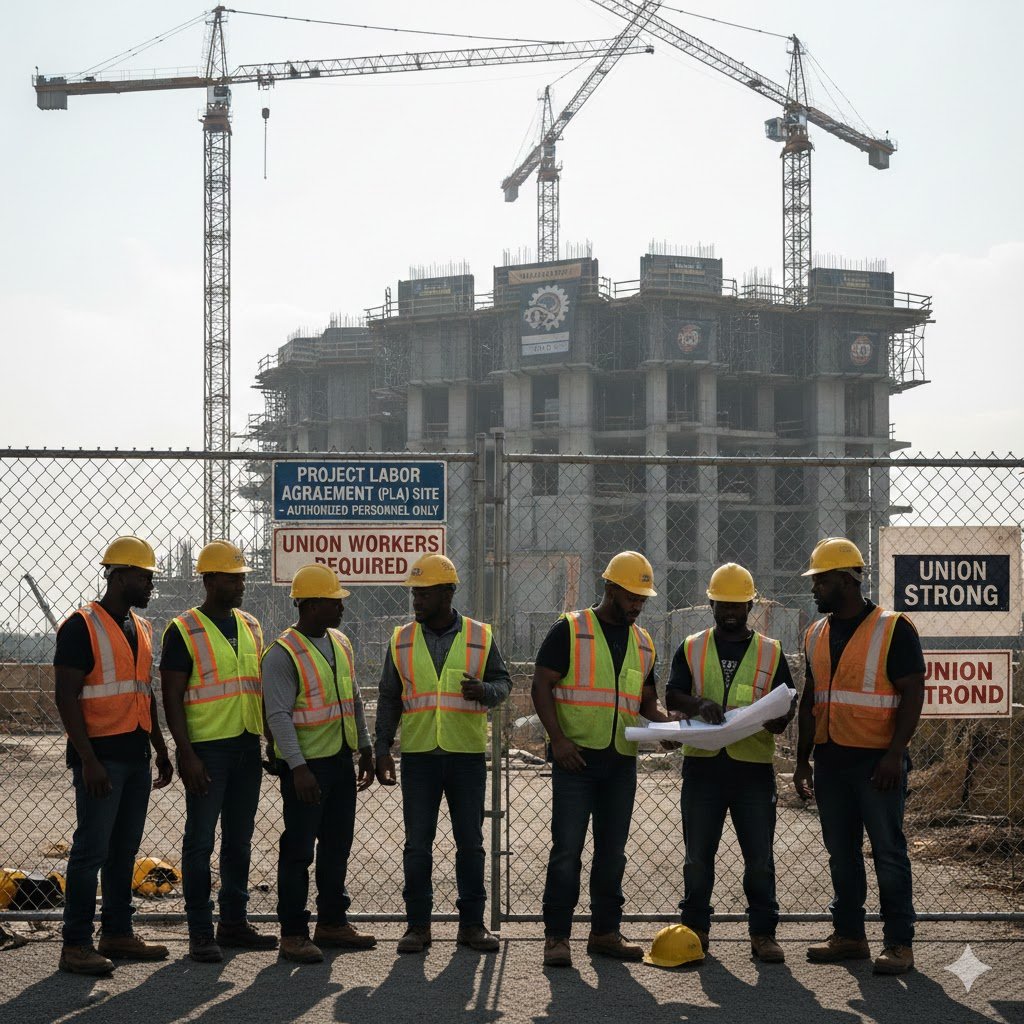
When the Blueprint Is Biased — How PLAs Limit Opportunity
On paper, PLAs sound simple enough: they ensure labor peace, streamline hiring, and keep big projects on schedule. But the fine print reveals a system where:
- Only union labor can participate
- Non-union firms must hire through the union hall
- Existing workers — overwhelmingly Black — may not be used
- Black-owned firms are often priced out before bidding even begins
That last point is the heart of the crisis.
Black construction firms tend to be smaller, leaner, and structured around non-union labor. When a PLA requires a contractor to replace their crew with union workers, the business model collapses. The bid becomes unworkable. The opportunity dies before it starts.
This is where the union preference meets a historical truth:
New Jersey’s construction unions remain overwhelmingly white.
When state-funded projects require union-only participation, the exclusion is not incidental. It’s baked in.
What AACCNJ and ABC-NJ Are Actually Saying — And Why It Matters Now
Two of the loudest voices challenging the status quo — the African American Chamber of Commerce of New Jersey (AACCNJ) and the Associated Builders and Contractors of New Jersey (ABC-NJ) — have called the PLA regime what it is:
a structurally discriminatory system wrapped in bureaucratic language.
AACCNJ President John Harmon has long warned that public contracting cannot claim diversity while simultaneously shutting out the workers and firms closest to the communities these projects serve.
ABC-NJ, representing a wide network of non-union builders, has echoed this critique with data:
When PLAs govern a project, Black firms participate at dramatically lower rates, even when they are qualified, competitively priced, and geographically rooted.
Both organizations are pushing for a legislative fix — not to eliminate PLAs entirely, but to raise the PLA threshold, ensuring only the most complex megaprojects require union-only labor.
It’s a simple correction with massive implications:
Give Black contractors and workers a fair shot at the billions flowing through the state economy.
“If the Work Is in Our Neighborhoods, Why Don’t We See Our People Working?”
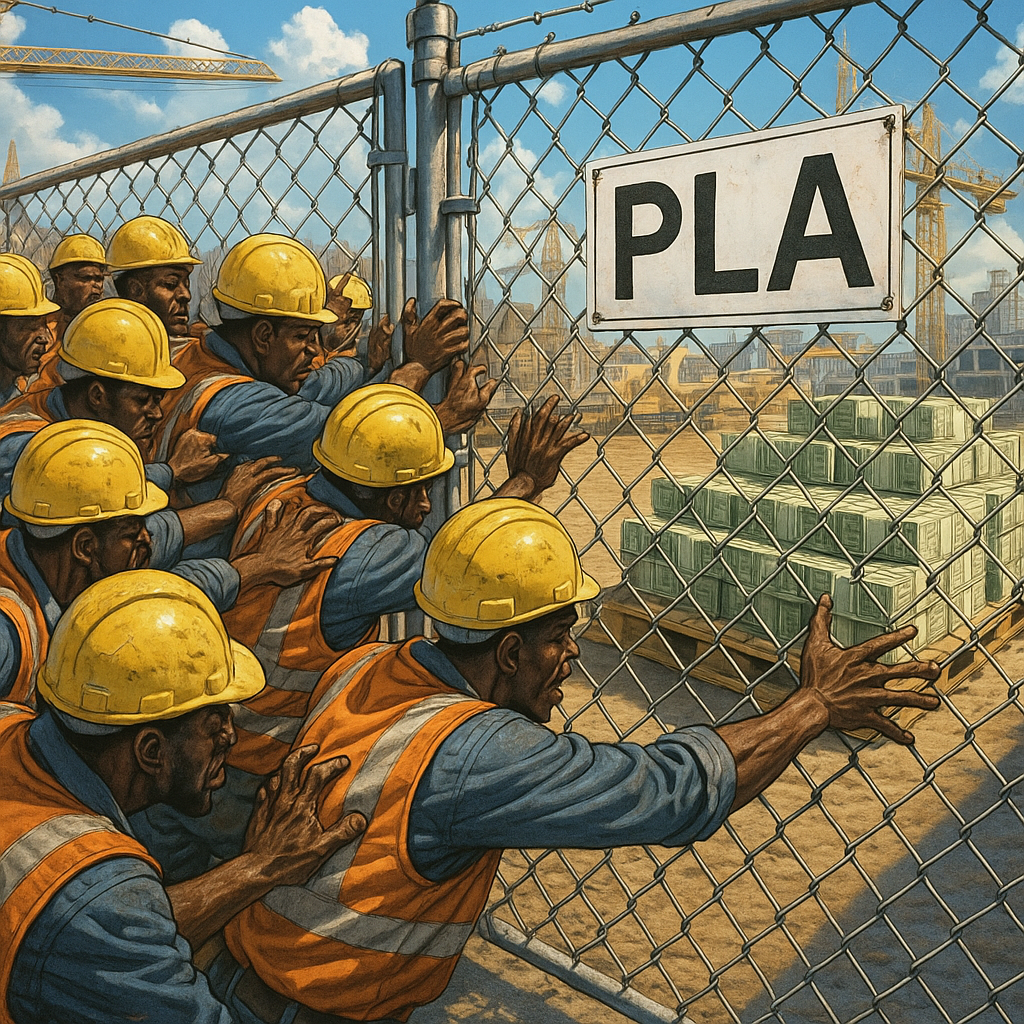
This question comes up repeatedly in Newark, Trenton, Camden, and Jersey City — cities where Black residents are the backbone of the community, but not the beneficiaries of public construction dollars.
Youths see gleaming new developments rising across their neighborhoods, but not their uncles, cousins, mentors, or neighbors on the job site.
This visibility gap shapes how young people perceive opportunity:
- Does the trades sector actually want Black talent?
- Can Black contractors scale without state support?
- Why does public money, their parents’ tax dollars, seem to bypass them?
For older generations, the issue hits differently.
It feels like déjà vu — yet another instance where Black labor builds prosperity without ever being allowed to own it.
If the future is being built in real time, and Black workers are excluded from that process, what does that say about who the future is being built for?
The PLA Paradox — Created for Fairness, Now Reinforcing Inequity
The irony is sharp: PLAs were originally intended to protect workers, maintain safety, and ensure stability. But the policy didn’t evolve alongside demographic shifts in the workforce.
As a result:
- White-majority unions maintain disproportionate control over labor pipelines
- Black-owned firms remain locked out of generational wealth opportunities
- Statewide infrastructure progress proceeds without community participation
It’s the kind of policy that looks neutral on paper but discriminatory in practice — what legal scholars call disparate impact.
And impact is everything.
When 98% of Black construction workers can’t compete, you’re not looking at coincidence. You’re looking at design.
Youth Are Paying Attention — And They See a System That Wasn’t Built for Them

Generation Z is deeply pragmatic. They follow the money, the structure, and the outcomes. They’re watching the rise of clean energy jobs, transportation revitalization, and digital infrastructure — and they’re asking why Black people aren’t centered in industries projected to shape the next 50 years.
When young people see:
- Construction jobs requiring union membership
- Union pipelines with limited Black representation
- Black contractors unable to scale
- Trade schools disconnected from real hiring networks
They conclude something that policymakers rarely admit out loud:
the system is not broken — it’s working exactly as intended.
If the infrastructure boom is truly the “new gold rush,” then the youth want to know why their community is still being told to wait outside the gate.
Short-Term and Long-Term Impacts — Why This Moment Is a Turning Point
Short-Term Impacts
- Black contractors continue losing bids, even for work in Black-majority cities
- Labor shortages worsen because non-union workers cannot be used
- Youth distrust grows, reducing interest in trade careers
- Public perception shifts, aligning with AACCNJ and ABC-NJ concerns
Long-Term Impacts
- A permanent racial wealth gap in construction assets and contracts
- Declining community control of development
- Fewer Black-owned firms surviving through economic cycles
- A generational loss of skilled trades knowledge
- Multi-decade displacement as revitalization happens to communities, not with them
Without reform, New Jersey risks creating a future where Black workers live in neighborhoods shaped by public investments, but never allowed to participate in building them.
So What’s the Fix? Raising the Threshold and Raising the Bar
The proposed solution — raising the PLA threshold — would free most small and mid-sized projects from union-only restrictions while keeping union safeguards for massive undertakings.
It’s not anti-union.
It’s pro-equity, pro-access, and pro-opportunity.
Raising the threshold means:
- Black contractors can finally bid competitively
- Workers can stay with their crews
- Communities gain economic participation
- The state gets more bidders, lower costs, and faster timelines
It is the rare policy change that benefits everyone, not just the well-connected.
But policy doesn’t move on fairness alone.
It moves on pressure.
The Takeaway — Build the Future, But Build It for Everybody
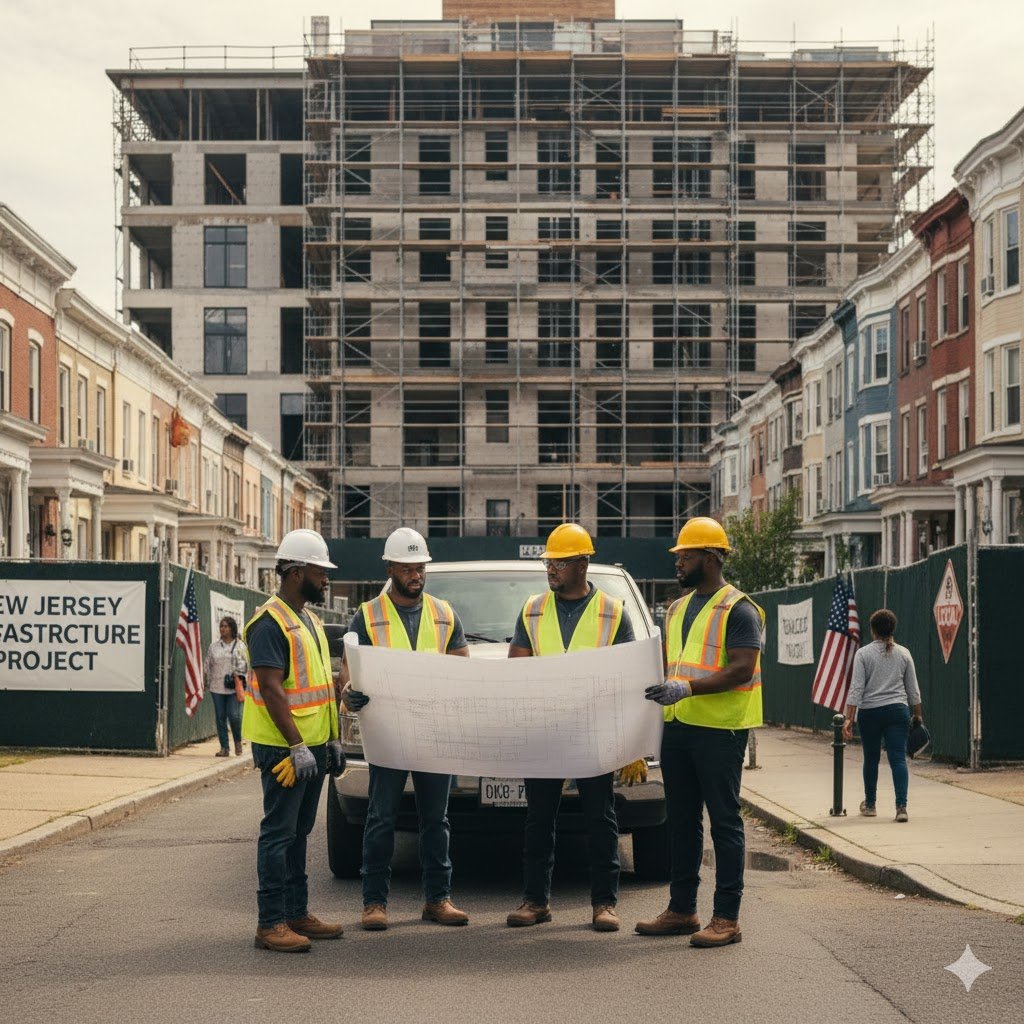
The fight over Black contractors and PLAs is not a niche issue. It’s a defining test of how states distribute power, capital, and opportunity.
If New Jersey gets this right, it becomes a national model for equitable development.
If it gets it wrong, it cements a two-tiered construction economy — one where Black workers remain permanently locked out of prosperity built on their backs.
The community deserves better.
Young people deserve better.
The future deserves better.
What Readers Can Do Next (Call to Action)
- Attend city council and state legislative meetings discussing PLA thresholds
- Support Black contractor associations and networks
- Ask local officials how many Black-owned firms were included on recent projects
- Encourage youth to join trades with mentorship pipelines, not exclusionary ones
- Share this article to push the conversation into rooms that often avoid it
Infrastructure is destiny.
So let’s make sure the people who live in New Jersey have a real hand in building it.
Related HfYC Content
- How to Get Involved with Your City Council, School Board, and Local Causes
- Brooklyn’s Cost of Living Crisis – Who Gets to Stay, Who’s Being Pushed Out?
- Unlocking the Dream: How the 203k Mortgage is Building Black Wealth in New Jersey
- The Silver Tsunami: How Boomers Are Winning the New Jersey Housing War
- Is the Housing Market for Black NJ Residents is Going Up in Smoke?
- $600K New Jersey Racial Wealth Gap = Gentrification Today + Homelessness Tomorrow
- Is the U.S. Housing Crisis a Bubble About to Burst—or a Slow Reset?
- What The Real Estate Moguls of NJ/NY Are Doing Right Under Your Nose
Other Related Content
References
- Associated Builders and Contractors of New Jersey. (2024). PLA policy impact report.
- African American Chamber of Commerce of New Jersey. (2024). Economic disparities in public contracting.
- New Jersey Legislature. (2023). Project Labor Agreement guidelines and thresholds.
-
-
-

-