The ‘No Kings’ Protest Is Here. Are We Joining, or Are We Tired?
Fam, you’ve seen the footage. It’s impossible to miss.
Millions of people flooding the streets in cities across the country. The sea of signs, the chants, the wall-to-wall news coverage. The No Kings protest movement, a massive nationwide demonstration against what organizers call the administration’s “authoritarian overreach,” is in full effect.
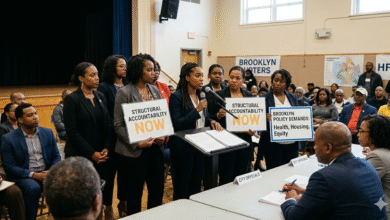
It’s a powerful sight. But pull up a little closer. Look at the faces in the crowd.
In many of these marches, from D.C. to Los Angeles, a question hangs in the air for us: Where are we?
It’s not a simple question, and it doesn’t have a simple answer. For Black Americans and the wider diaspora, this moment isn’t just a political debate; it’s a deep, complex, and, frankly, exhausting conversation. The question on social media and in our group chats isn’t just, “Are you going?” It’s, “Should we even have to go?”
Is this our fight to lead, another battle in a long war for justice? Or is it a moment to pause and ask why, when we march, the story is so different?
Let’s be real and break this down. The No Kings protest is forcing a critical conversation within our community: Should we join the rally, or are we right to “mind our business” after centuries of being the nation’s conscience?
What’s the ‘No Kings’ Protest Really About?
First, let’s get the facts. This isn’t just a random protest. According to organizers and reports, the “No Kings” name is a direct clapback at the administration’s own rhetoric, which has at times used monarchical language and imagery.
The movement is a broad coalition of groups, including organizations like the ACLU, Indivisible, and MoveOn, all pushing back against a specific set of actions they see as a threat to democracy.
What are they protesting?
- Executive Overreach: A feeling that the administration is ignoring the checks and balances of Congress and the courts.
- Authoritarian Policies: This includes the use of federal agents in cities, the crackdown on immigration, and the administration’s “mass-deportation efforts.”
- Threats to Civil Liberties: This is a big one. We’re talking about widespread concerns over government surveillance, including the use of facial recognition and phone hacking to monitor activists.
When you read that list, it’s hard not to see our community. “Crackdown on immigration”? That’s our Haitian, Nigerian, and Jamaican brothers and sisters. “Government surveillance”? We’ve been the targets of that since COINTELPRO. “Cuts to social programs”? That’s our food security, our housing, and our healthcare on the line.
So, if these policies are a direct hit on us, why is there any hesitation? Why isn’t every Black community org, church, and fraternity chapter leading the charge?
The answer, fam, is memory.


The Elephant in the Room: “Black People Are Tired”
There’s a headline from The Brooklyn College Vanguard that’s been making the rounds, and it gets right to the heart of it: “Black People are Tired: Why the ‘No Kings’ Protest Didn’t Work.”
That single sentence captures the mood of so many. This isn’t apathy. It’s exhaustion.
Let’s rewind the clock to 2020. When we took to the streets for George Floyd and Breonna Taylor, we were called “violent.” We were met with the National Guard. The media narrative, fueled by our critics, was one of “riots,” “looting,” and “destruction.” We marched for our lives and were vilified for it.
Now, fast forward to today. The “No Kings” protest, which is largely white, is being praised in much of the media for its “unity,” “festive atmosphere,” and “joyful acts.”
The difference is… loud.
And it’s left many in our community feeling a type of way. It feels like we are, once again, being asked to clean up a mess we didn’t make. As the Vanguard article puts it, “Black people are no longer fixing a system they didn’t build or break.”
There’s a deep-seated frustration that when we ask for help, we are left to fend for ourselves. But when the foundations of the entire system start to crack and affect everyone, we’re suddenly expected to be on the front lines, banner in hand, to “save democracy” for the very people who were silent when we were screaming.
Voices from the Community: “I Just Try to Live My Life”
This “weary distance” is showing up in conversations from the barbershop to the group chat. The Minnesota Spokesman-Recorder, in a piece about the protest, captured this mood perfectly. They found a community divided not by if the administration is a problem, but by how to engage with that problem.
The Youth View: “Terrified, But Tired”
This is hitting the younger generation in a specific way. One 24-year-old Black woman in Minnesota told the Spokesman-Recorder that she is “terrified,” feeling like “nothing is set up for me” and that “what little there was is being taken away.”
She embodies the paradox of our youth: they are more informed, more engaged, and more outspoken than any generation before them. They see the danger. But they are also the generation that came of age during a pandemic, saw the hope of 2020 met with brutal force, and are now facing an economy that feels rigged against them.
They are simultaneously the most likely to understand why the protest is happening and the most likely to feel, as the young woman said, that they have “little control over it.” The question for them isn’t “Is it bad?” It’s “Will this protest actually fix it, or is it just more noise?”
The Elders’ View: “We’ve Seen This Movie Before”
Our elders, the ones who were on the front lines of the Civil Rights Movement, are looking at this with a different lens. There’s a deep, historical understanding. They “support anybody’s right to protest,” as one 48-year-old woman said.
But they also bring caution. They know that a protest isn’t a strategy. It’s a tactic. They’ve seen mass movements rise and fall. They’ve seen energy wasted on spectacle without a clear, actionable plan.
Their hesitation isn’t a lack of fight; it’s a demand for strategy. They are the ones asking: “Okay, you marched. What happens Monday? What’s the real goal beyond the sign? And is this movement built to last, or will it fade when the media gets bored?”
This cross-generational mix of exhaustion and strategic caution is the real story of the Black response to the No Kings protest.

But Are the Stakes Too High to Be Tired?
Here’s the other side of the coin. Being tired is valid. But what if the house is on fire?
The hard truth is that the very policies the “No Kings” movement is protesting are disproportionately aimed at us. While we debate whether to join, the surveillance state is being perfected on us.
Civil liberties groups are sounding the alarm about the tech being used—facial recognition, cell-site simulators (that track your phone), and social media monitoring. These aren’t abstract threats. These are the tools that will be used to label our community organizers as “threats,” to track our activists, and to dismantle our support networks.
When the administration doubles down on “mass-deportation efforts,” that’s not a “white people’s problem.” That is a direct attack on the entire African diaspora—on our families and neighbors from the Caribbean and the Continent who are just as much a part of our community as those of us born here.
Can we afford to “mind our business” when the business of the day is actively dismantling our communities?
This is the central, painful conflict: our bodies are tired, but our futures are on the line.
Beyond ‘Join or Not’: A New Path Forward

So, what’s the move, fam?
Maybe the choice isn’t a simple “yes” or “no.” Maybe the binary choice of “join them” or “stay home” is a trap.
Our history has never been about just joining someone else’s parade. It’s been about building our own floats. It’s been about strategy. It’s been about community.
The exhaustion we feel is real. It’s a symptom of a deep, systemic wound. And you can’t heal a wound by pretending it doesn’t hurt. Acknowledging our tiredness isn’t weakness; it’s the first step to a smarter fight.
If the “No Kings” protest shows us anything, it’s that we have to be our own saviors. Our power isn’t just in our protest signs; it’s in our endurance, our institutions, and our dollars.
Key Takeaways
- The No Kings protest is a massive movement, but our community’s response is complex.
- This isn’t apathy. It’s exhaustion. We are tired of being the first to fight and the last to be heard.
- The media’s different portrayal of the “No Kings” protest (festive, unified) versus BLM (violent, destructive) highlights a painful double standard.
- Youth are “terrified” but “weary,” while elders are “cautious” and demand “strategy.”
- The threats are real: surveillance and anti-immigrant policies are direct attacks on Black and diaspora communities.
Our Call to Action
The path forward isn’t about just being in the street; it’s about being strategic.
- Rest and Heal. First, give yourself and your people grace. The exhaustion is valid. We can’t pour from an empty cup.
- Talk to Each Other. Have this exact conversation. Host a community forum. Get the youth and the elders in the same room. Why are we tired? What would a movement that centers us look like?
- Build Our Own Tables. Instead of just joining their march, let’s pour that energy into our things. Support Black-owned media (like Here For You Central!). Buy from Black-owned businesses. Donate to your local, Black-led mutual aid fund.
- Vote. And Then Some. A protest is a moment. A vote is a lever. As one man told the Spokesman-Recorder, the answer is to “Get out and vote.” But don’t stop there. Run for school board. Go to your city council meeting. Power isn’t just in D.C.; it’s in our backyard.
We don’t have to be the sacrificial lambs for a democracy that often forgets us. We can be the architects of our own liberation. We can be tired, and we can still be strong. We can be strategic, and we can be us.
And that, fam, is a power no king can ever take away.
Related HfYC Content
- The Enduring Foundation: How New Jersey’s Black Churches Fueled a Movement and What That Means for Us Today
- Digital Eyes, Enduring Bias: How Surveillance Tech Threatens New Jersey’s Black Community
- Hashtag to Action: How NJ’s Black Gen Z Is Rewriting the Rules of Social Change
- Paterson’s Gamble: Trading Home Rule for Human Rights in a City on the Edge
Other Related Content
- “As ‘No Kings’ protests decry Trump, surveillance worries emerge” – Reuters.
- “We’ve got to do something: Thousands attend ‘No Kings’ protests in Alabama” – Alabama Reflector.
References
- “Live Coverage: No Kings National Day of Action.” (2025, October 17). American Civil Liberties Union. Retrieved from https://www.aclu.org/news/civil-liberties/live-coverage/no-kings-national-day-of-action
- “As ‘No Kings’ protests decry Trump, surveillance worries emerge.” (2025, October 18). Reuters. Retrieved from https://www.reuters.com/world/us/no-kings-protests-decry-trump-surveillance-worries-emerge-2025-10-18/
- “‘We’ve got to do something:’ Thousands attend ‘No Kings’ protests in Alabama.” (2025, October 18). Alabama Reflector. Retrieved from https://alabamareflector.com/2025/10/18/weve-got-to-do-something-thousands-attend-no-kings-protests-in-alabama/
- About – No Kings Movement. (n.d.). Retrieved from https://www.nokings.org/about-nk