Brooklyn’s Digital Lifeline: How the NYC Digital Equity Roadmap 2025 Hits Home
If you live in Brooklyn, you don’t need a policy memo to tell you that Brooklyn digital equity is a survival issue. It shows up when a kid in East New York is doing homework on a cracked phone, when a Crown Heights grandma has to stand outside a library for Wi-Fi, or when a Flatbush entrepreneur is losing clients because video calls keep dropping.
In March 2025, New York City officially put all of that on paper with the NYC Digital Equity Roadmap — a plan backed by new funding, new positions, and new programs designed to close the city’s digital divide, with a special focus on disadvantaged communities.
For Black Brooklyn, where tech access, housing pressure, and rising costs all collide, this roadmap isn’t just another City Hall announcement. It’s a question: will these promises translate into real power, or just better press releases?
The Wi-Fi Struggle Is Real — Why Brooklyn Digital Equity Matters
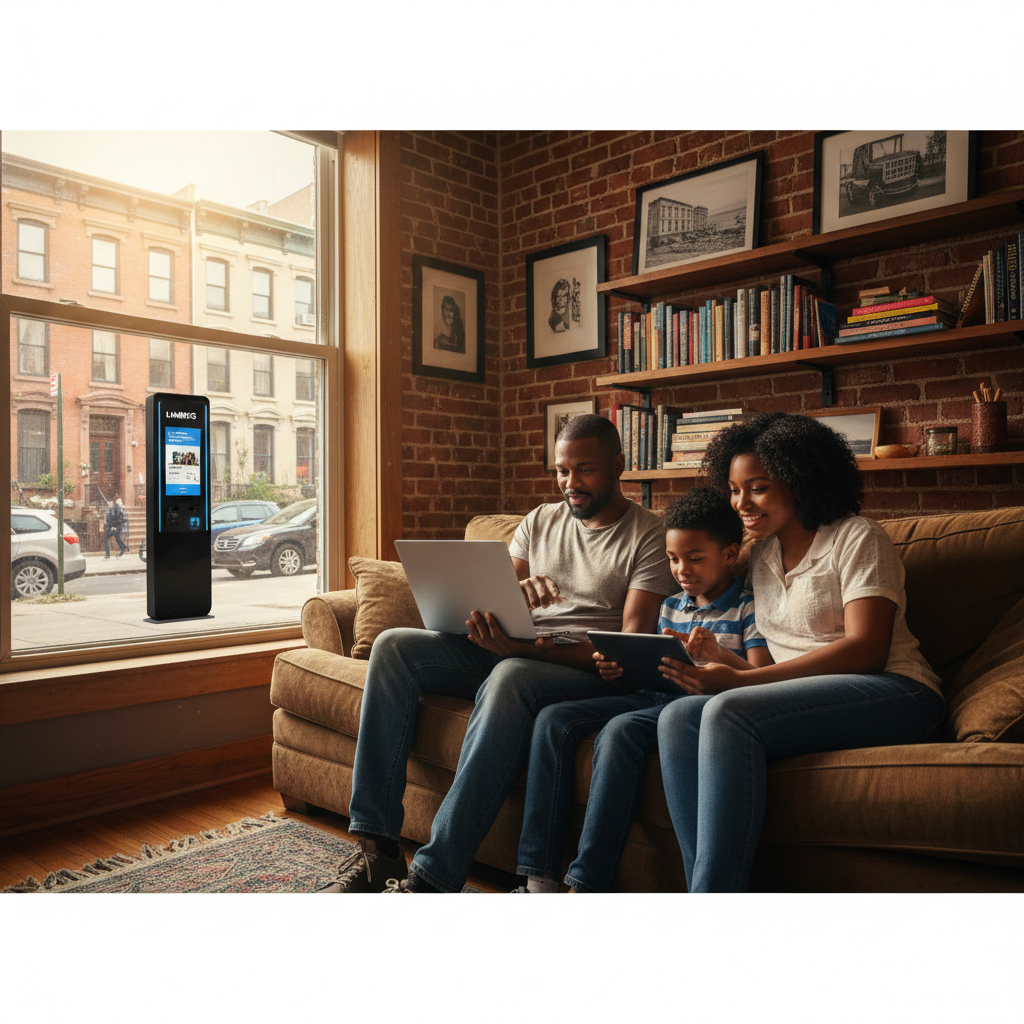
Before we get into programs and acronyms, let’s name the reality. Brooklyn is home to some of the most culturally rich Black neighborhoods on Earth — Bedford-Stuyvesant, Flatbush, East New York, Brownsville, Canarsie, Crown Heights and more. But behind the murals and brownstones sits a hard truth:
- Many households are internet-poor but bill-rich. The rent is high, groceries are high, but broadband still hits like an extra utility bill.
- Devices are often shared — one laptop for a whole household, or homework happening on a parent’s phone in between WhatsApp calls.
- The same communities that got redlined out of mortgages are now being redlined out of high-quality connectivity— slower speeds, less reliable service, and fewer options.
For young people, especially Black youth in Brooklyn, digital access is not optional. It decides whether you can:
- Turn in assignments on time.
- Learn coding, editing, or design skills.
- Apply for jobs, gigs, or internships.
- Tap into telehealth, mental health support, and financial tools.
That’s why the Brooklyn digital equity conversation is really about economic justice, education justice, and future-proofing the borough for the next generation.
What Is the NYC Digital Equity Roadmap, Really?
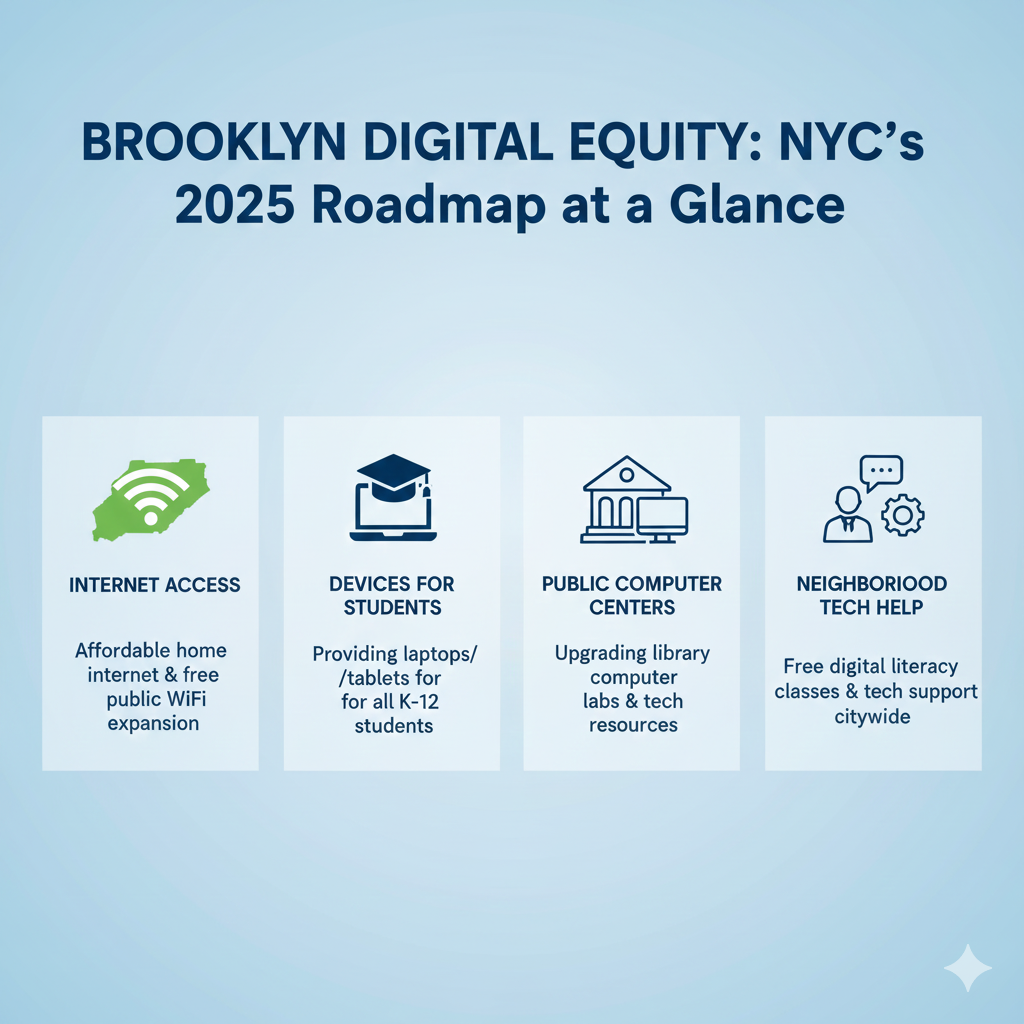
In March 2025, Mayor Eric Adams and Chief Technology Officer Matthew Fraser released the NYC Digital Equity Roadmap, alongside a $2.4 million capital investment aimed at underserved communities.
The roadmap does a few big things:
- Sets a citywide vision for closing the digital divide, defining digital equity and laying out how agencies should coordinate.
- Launches 11 new initiatives, including:
- A Digital Equity Working Group to coordinate across agencies.
- A new Chief Digital Equity Officer to keep digital inclusion from becoming an afterthought.
- Renovations of computer labs in public libraries and older adult centers across all five boroughs.
- Expansion of NYCHA mobile computer labs, literally rolling tech access into public housing communities.
- Builds on existing programs like:
- Big Apple Connect, which now provides free in-home internet and basic cable to about 330,000 residents across 220 NYCHA sites, saving families over $1,700 a year on average.
- LinkNYC and Link5G, replacing old pay phones with Wi-Fi kiosks and 5G infrastructure in high-need neighborhoods.
- More than 450–500 public computer centers in libraries, schools, and community hubs that offer devices, internet, and digital literacy classes.
All of that sounds impressive on paper. But what does it look like on the block in Brooklyn?
Brooklyn on the Front Lines of the Digital Divide
Let’s talk geography.
The roadmap is citywide, but the digital equity fight in Brooklyn is concentrated in neighborhoods the city itself classifies as “disadvantaged” — places with higher poverty, more public housing, and lower historic access to broadband.
Bed-Stuy, Brownsville, East New York, Flatbush
In these neighborhoods, digital equity is tangled up with:
- Housing instability — people moving frequently, doubling up, or living in shelters makes broadband contracts harder to keep.
- Legacy disinvestment — aging buildings, outdated wiring, and fewer high-end providers.
- Language and literacy barriers — particularly in Flatbush and East Flatbush, where Caribbean, African, and Central American communities may be navigating English, legal paperwork, and tech all at once.
The roadmap offers some targeted relief:
- Big Apple Connect is already active at NYCHA complexes in Brooklyn, meaning thousands of residents are eligible for free in-home broadband.
- Neighborhood Tech Help, launched in April 2025, sends tech staff into affordable housing developments and community centers to help low-income tenants get online, avoid scams, and actually use digital services.
- Renovated computer labs in Brooklyn Public Library branches and older adult centers will give youth and elders alike more safe, local spaces to learn digital skills.
For Black Brooklyn, that means the city isn’t just dropping Wi-Fi kiosks and walking away — at least on paper, it’s pairing infrastructure with human support and training, which is where real change happens.
Young, Black, and Offline — Until Now
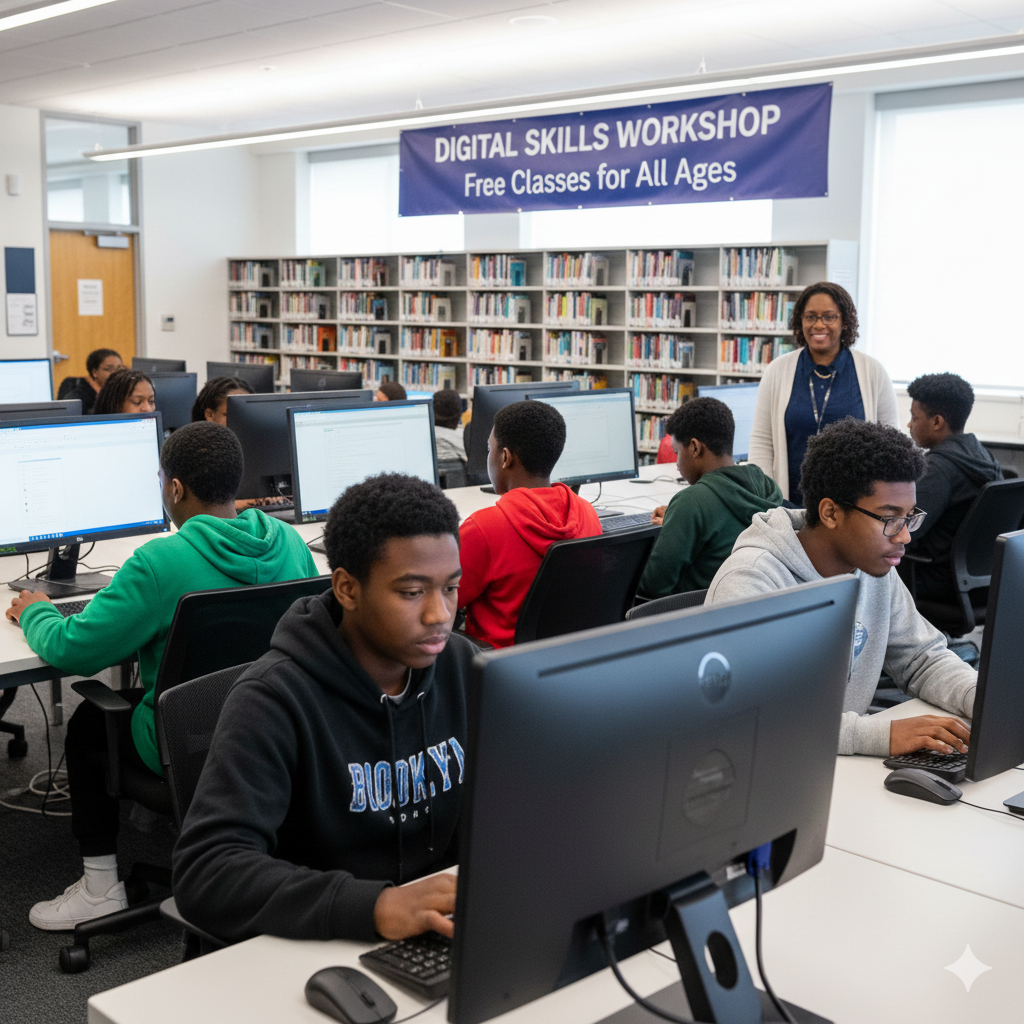
If you zoom in on young Brooklynites, the stakes are even higher.
In fall 2025, the city announced a plan to distribute 350,000 free LTE/5G-enabled Chromebooks to NYC public school students, prioritizing high-need schools, students in temporary housing, and high-poverty areas.
For Brooklyn youth, especially in Central and East Brooklyn, that means:
- A child doesn’t have to borrow their parent’s phone to upload homework.
- Teens interested in coding, editing, or content creation can access real software — not just mobile apps.
- Kids in shelters or unstable housing can still get online because the devices carry their own connectivity.
When you layer that on top of public computer centers, mobile labs, and LinkNYC/Link5G kiosks, you get the beginning of a Brooklyn digital equity ecosystem:
- Devices in students’ hands.
- Connectivity through Big Apple Connect, LTE/5G, and public Wi-Fi.
- Skills training at libraries, community centers, and Neighborhood Tech Help sites.
For Gen Z and Gen Alpha kids in Brooklyn, that can be the difference between scrolling and building — between being just a consumer of content and becoming a creator, coder, or entrepreneur.
Federal Cuts, State Fights, and Local Reality
There’s a bigger backdrop here.
In July 2025, New York State announced it was putting over $5 million of its own money into digital equity grants after the Trump administration cut all federal funding for national digital equity and education programs.
That move matters for Brooklyn because:
- It keeps grant money flowing to local orgs doing device distribution, skills training, and outreach.
- It shows that even when the federal government backs away from digital equity, state and city policy can still move, especially when communities push.
But it also reminds us that this work is fragile. One administration can fund digital equity; another can gut it. That’s why Brooklyn activists, parents, and youth organizers are treating the roadmap as a tool, not a miracle — something to leverage, monitor, and, if necessary, critique loudly.
Beyond Wi-Fi — What Digital Equity Can Unlock for Brooklyn
When we talk about Brooklyn digital equity, we’re really talking about power:
- Economic power: A laid-off worker in East New York can pick up remote customer service work if they have stable internet and basic digital skills.
- Educational power: A high schooler in Flatbush can enroll in online college courses, coding bootcamps, or design classes from their bedroom — not just from a crowded library.
- Health power: Elders in Brownsville with chronic illnesses can use telehealth, refill prescriptions online, or join virtual support groups.
- Civic power: Brooklyn residents can track City Council meetings, organize tenants’ unions, and report issues through digital portals.
For Black communities that have carried Brooklyn’s culture for decades, digital equity is part of staying rooted in a borough under pressure from rising rents, displacement, and policing. Tech access can’t fix everything — but without it, we’re locked out of too many solutions.
Short-Term Wins vs. Long-Term Questions
Short-Term Wins
In the next 1–2 years, Brooklyn stands to gain:
- Renovated computer labs and more public tech spaces in libraries and older adult centers.
- Expanded Neighborhood Tech Help pop-ups at affordable housing sites.
- More LinkNYC/Link5G nodes in outer-borough neighborhoods that have been under-connected.
- Tens of thousands of Brooklyn public school students getting LTE/5G Chromebooks tied into the city’s broader digital equity strategy.
Long-Term Questions
But the long game is more complicated:
- Will Big Apple Connect and device programs be renewed after political winds shift?
- Will the Chief Digital Equity Officer and Working Group have real power, or just advisory status?
- Will Link5G and other infrastructure investments benefit residents, or just make it easier for high-end developers and luxury buildings to sell “smart living”?
For Black Brooklyn, the real measure of Brooklyn digital equity won’t be how many kiosks go up, but how much poverty comes down, how many youth get into high-wage tech pathways, and how many elders stay connected without being scammed or priced out.
What Brooklyn Can Do With (and About) the Roadmap
Policy is one lane; community is another. Here’s how residents, youth, and local orgs can move in parallel with the roadmap:
- Claim the resources.
- Visit local libraries and ask specifically about digital literacy classes, device lending, and Neighborhood Tech Help hours.
- If you live in NYCHA, confirm whether your building is covered by Big Apple Connect and what it takes to enroll.
- Organize around gaps.
- If your block still doesn’t have reliable service, document it and bring that data to City Council members, community boards, and digital equity coalitions like NYCADE.
- Turn access into opportunity.
- Youth groups can host hack nights, content labs, or digital co-working spaces using Chromebooks and public centers.
- Elders can be trained as digital ambassadors for their churches, tenants’ associations, and social clubs.
- Watch the numbers.
- Ask: how many Brooklyn residents are actually being served each year? Which ZIP codes are benefiting? Whose languages are included in outreach?
Because in the end, digital equity is not just about connecting devices — it’s about connecting people to power.
Key Takeaways — Brooklyn’s Digital Future Is a Justice Issue
Let’s distill it down:
- Brooklyn digital equity is about survival, not luxury.
In a borough facing rising costs and displacement, internet access, devices, and digital skills are essential for work, school, health, and organizing. - The 2025 NYC Digital Equity Roadmap is a real step — but not a finish line.
With $2.4 million in new investments, new roles, and 11 initiatives, the roadmap gives Brooklyn communities more tools to push for change, especially when paired with state digital equity grants and school Chromebook programs. - Brooklyn’s Black neighborhoods are central, not side notes.
From NYCHA sites using Big Apple Connect to libraries in Bed-Stuy, East New York, and Flatbush, Black communities are where the digital divide — and the solutions — are most visible. - Youth are the frontline beneficiaries and leaders.
When kids and teens get reliable devices, connection, and training, they don’t just consume culture — they shape it, monetize it, and use it to build futures. - Community pressure will decide whether this roadmap becomes reality.
Without organizing, oversight, and consistent demands from Brooklyn residents, digital equity risks becoming a slogan instead of a standard.
Call to Action:
If you’re in Brooklyn, pick one action this month:
- Help a young person or elder sign up for a digital literacy class.
- Ask your local library what digital programs they offer — and what they need.
- Join or follow a digital equity coalition, and stay loud about what’s working and what’s not.
The city has finally put Brooklyn digital equity in writing. Now it’s on us to make sure those words turn into Wi-Fi, skills, and opportunities that actually reach our people.
HfYC Daily Poll
When you look at Brooklyn’s digital equity push — free Wi-Fi, Chromebooks, tech help — does it feel like real change for our people or just a prettier version of the same old struggle? Follow us and respond on social media, drop some comments on social media, or write your own spin on the article!
Alternative Perspectives:
- If the city can light up Brooklyn with 5G and LinkNYC kiosks, but your cousin still has to do job apps on borrowed Wi-Fi, is that digital equity or digital gentrification?
- Do you think NYC’s 2025 Digital Equity Roadmap will actually close the tech gap for Black Brooklyn neighborhoods, or will most of the benefits miss the people who need them most?
- Be honest: when the city says “Brooklyn digital equity,” do you picture your block getting real Wi-Fi and skills — or just another kiosk you walk past on the way to someone else’s opportunity?
Related HfYC Content
- The New Redline: Bridging the Digital Divide
- Digital Eyes, Enduring Bias: How Surveillance Tech Threatens New Jersey’s Black Community
- The Audible Enigma: Is the Tech Giant a True Partner to Black Newark?
- AI on the Frontlines: How Large Language Models, Automated Workflows, and AI Agents Are Transforming Life and Work
Other Related Content
- NYC Digital Equity Roadmap: 11 Initiatives to Close the Digital Divide
- Mayor Adams and CTO Fraser Announce $2.4 Million Investment for Digital Equity
- NYC Digital Equity and Device Access for Students (Chromebook Initiative)
- New York City Alliance for Digital Equity (NYCADE)
References (APA Style)
- Mayor’s Office of the City of New York. (2025, March 7). Mayor Adams, Chief Technology Officer Fraser announce $2.4 million investment, release roadmap to advance digital equity in disadvantaged communities. https://www.nyc.gov/office-of-the-mayor/news/129-25/mayor-adams-chief-technology-officer-fraser-2-4-million-investment-release-roadmap-to
- New York City Office of Technology & Innovation. (2025). The New York City Digital Equity Roadmap.https://www.nyc.gov/assets/oti/downloads/pdf/DE-Roadmap.pdf
- New York City Office of Technology & Innovation. (2025). Mayor’s Management Report: Office of Technology and Innovation. https://www.nyc.gov/assets/operations/downloads/pdf/mmr2025/oti.pdf
- Mayor’s Office of the City of New York. (2025, September). Mayor Adams to distribute 350,000 free, brand-new Chromebooks with internet access to public school students, advancing commitment to close digital divide.https://www.nyc.gov/es/mayors-office/news/2025/09/mayor-adams-to-distribute-350-000-free–brand-new-chromebooks-wi
- New York City Department of Housing Preservation and Development. (2025, April 21). City launches ‘Neighborhood Tech Help’ to bridge digital divide across the boroughs. https://www.nyc.gov/site/hpd/news/015-25/city-launches-neighborhood-tech-help-bridge-digital-divide-across-boroughs
- Governor’s Press Office, New York State. (2025, July 23). Governor Hochul announces over $5 million digital equity grant opportunity to expand internet use and skills statewide. https://www.governor.ny.gov/news/governor-hochul-announces-over-5-million-digital-equity-grant-opportunity-expand-internet-use
- New York City Alliance for Digital Equity. (2025). NYCADE – Home.https://www.nycade.org/